






























In 2006, Professor Shinya Yamanaka's group at Kyoto University succeeded in creating the world's first "iPS cells. These iPS cells are now being used not only for regenerative medicine but also for the development of new drugs. iPS cells" are "pluripotent stem cells" that can change their role to any type of cell and proliferate almost indefinitely. Therefore, it is thought that the creation of "iPS cells" from patients' cells and reproduction of diseases outside the body will make it easier to find effective and safe drugs. Expectations for the development of new drugs using "iPS cells" are increasing.






Along with the remarkable development of medicine, pharmaceuticals are also undergoing a new evolution. One of the most notable developments is the development of therapeutic drugs called "antibody drugs. These drugs artificially utilize the immune function that is innate in humans to treat diseases. They have few side effects and are expected to be highly effective in treating diseases and conditions that have been difficult to treat in the past, and are being used to treat cancer, autoimmune diseases such as rheumatoid arthritis and Crohn's disease, and infectious diseases.




Molecularly targeted drugs," which pinpoint and target only bad cells such as cancer without damaging normal cells, are another type of therapeutic drug that is attracting attention.
Since they work directly on genes that cause diseases, higher therapeutic effects can be expected. In addition, compared to conventional anticancer drugs, these drugs have fewer side effects and can reduce the disruption to daily life.
Many of these molecular-targeted drugs and antibody drugs are called "biopharmaceuticals," which are produced using biotechnologies such as genetic recombination and cell fusion, and are making a significant contribution to the advancement of treatment.
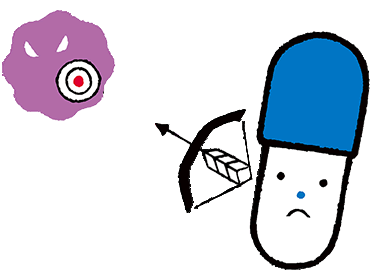
![Delivering drugs to the desired location only (Drug Delivery System [DDS])](img/hs_index_003.png)
![Delivering drugs to the desired location only (Drug Delivery System [DDS])](img/hs_index_003_pc.png)
A drug delivery system (DDS) is a technology that delivers a drug directly to the desired location, in the required amount, and at the required time. The DDS technology is highly effective because it targets and delivers the drug only to the affected area, and it also minimizes side effects.
DDS technology is also advancing day by day, and it is now possible to deliver drugs to the inside of cells by filling them into "nanocapsules," which are so tiny that they can only be seen with the aid of a special microscope.



Genomic drug discovery is a drug discovery method that uses the vast amount of genetic information (genome) accumulated to date to identify disease-causing genes and proteins and to find substances that act on them. Recently, the use of supercomputers and other technologies has made it possible to shorten the development period, potentially reducing development costs, and to conduct development in a more logical and scientific manner.
At the same time, tailor-made medicine, in which the genome of each individual patient is analyzed using this technology to deliver drugs that match the constitution of each person, even for the same disease, is also attracting attention.