


Topics Joint Assembly of Drug Evaluation Committee and Regulatory Affairs Committee for FY 2024
The "FY2024 Joint Assembly of Drug Evaluation Committee and Regulatory Affairs Committee" was held on April 25, 2024 at the Nihonbashi Life Science Hub (Chuo-ku, Tokyo). This Joint Assembly was held in a hybrid format, with special lectures by speakers from the Ministry of Health, Labor and Welfare (MHLW) and the Pharmaceuticals and Medical Devices Agency (PMDA). Approximately 70 JPMA executives and executives of the Drug Evaluation Committee and Regulatory Affairs Committee participated in the meeting at the venue, while other committee members participated online.
The Assembly was opened with an opening address by Yuji Kashitani, Chairperson of the JPMA Regulatory Affairs Committee. Six special speakers, Yasunori Yoshida, Deputy Director General, Minister's Secretariat, MHLW; Kiyoto Nakai, Shinichi Takae, Yumiko Nomura, and Daisaku Sato of the Pharmaceutical Affairs Bureau; and Kenichi Tamiya of the PMDA, shared information on recent trends in pharmaceutical administration, responses to drug loss and other issues, expectations for companies, and new developments in PMDA operations. The session concluded with a presentation on the Pharmaceuticals and Medical Devices Act (PDDMA).
Recent Trends in Pharmaceutical Administration
Deputy Director-General, Minister's Secretariat, Ministry of Health, Labour and WelfareYasunori Yoshida Mr. Yasunori Yoshida, Deputy Director-General, Pharmaceutical Affairs Bureau, MHLW
First, as a recent development in the pharmaceutical administration, Mr. Tamiya talked about the society to be realized by the digital transformation (DX) of medical care. Then, as an overview of the revision of the Next Generation Medical Infrastructure Act, he explained the utilization of pseudonymized processed medical information related to medical DX, the linkage with public databases such as receipt information and the database of information on specific health checkups (NDB), and the key points and background and details of the working group's study on secondary use of medical and other information. Explanation was also given on the background and details of each of these issues.
mata、The purpose and outline of the amendment of the Clinical Research Act, etc. were explained.、 In addition, as a movement after the expert panel on comprehensive measures to realize a rapid and stable supply of pharmaceuticals・ and stable supply of pharmaceuticals, as well as the movement after the expert panel on comprehensive measures to、 Strengthening drug discovery capabilities・ Study group on pharmaceutical regulations to ensure a stable supply of pharmaceuticals、 Industrial structure to realize stable supply of generic drugs The points of discussion and the schedule for the future were shared.
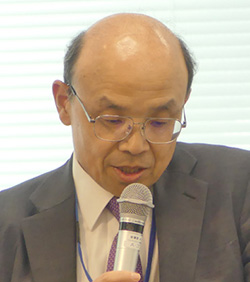
Finally, he explained the four main themes of the revision of the Pharmaceuticals and Medical Devices Act (Pharmaceuticals and Medical Devices Act), including the need to establish a safe and prompt approval system in order to resolve issues related to access to pharmaceuticals, such as drug loss and supply shortages. It was reported that each theme will be examined in the future, and the discussions will be organized by July 2024.
Recent Topics on New Drug Review -Drug Loss Response, etc.
Mr. Kiyoto Nakai, Director, Drug Evaluation and Management Division, Pharmaceuticals Bureau, MHLW
In regard to the recent hot topic of drug lag/loss, the following eight issues were discussed and the direction of action was explained.
| (1) | Orphan Drug Designation |
| (2) | Development of pediatric application |
| (3) | Japanese P1 study for participation in global clinical trials |
| (4) | Review of manufacturing methods for pharmaceutical products |
| (5) | International survey and information dissemination on pharmaceutical regulations |
| (6) | (6) Arrangement of the necessity of Japanese data in validation studies, etc., and the ideal system for expedited approval |
| (7) | (7) How post-marketing drug use-results surveys should be conducted and how real-world data (RWD) should be utilized |
| (8) | (8) Further streamlining of clinical trials (clinical trial ecosystem) |
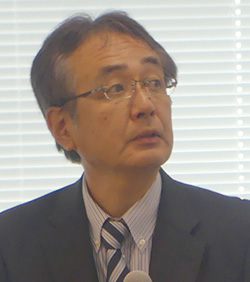
Finally, the position of Japan in the global sales of ethical drugs by region and country was shared, and it was stated that Japan would aim to improve the public health and take measures against drug loss.
Trends surrounding programmed medical devices (SaMD)
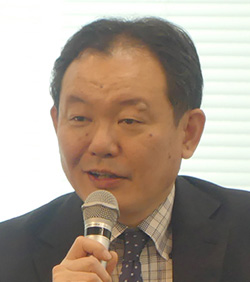
Mr. Shinichi Takae, Director, Medical Devices Evaluation and Management Division, Pharmaceuticals Bureau, Ministry of Health, Labour and Welfare (MHLW)
First, the options for applying for manufacturing and marketing approval of programmed medical devices were explained, and specific systems for promoting development were introduced. After sharing the details of the study on the trial implementation of priority review, etc. for programmed medical devices, the main consultations regarding the review of programmed medical devices were explained and a request was made to make use of the consultations. After that, a detailed explanation of the Package Strategy 2 (DASH for SaMD 2) was given, and finally, as a topic of discussion, the status of studies on "Generative AI" within the LDP and the MHLW was introduced.
Prospects for drug safety operations and expectations of companies
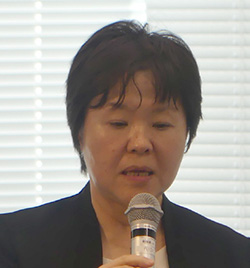
Ms. Yumiko Nomura, Director, Drug Safety Division, Pharmaceutical Affairs Bureau, Ministry of Health, Labour and Welfare
At first, he explained the safety measures and the studies leading up to them. Once again, he emphasized the need to move the evaluation of information and measures for safety measures in two different modes: rapid response and implementation based on frequency evaluation, etc. He also introduced the study conducted by MHLW and PMDA on the promotion of efforts to enhance the provision of information to users through electronic accompanying documents by utilizing RWD such as databases (DB) for post-marketing safety measures, along with specific examples of their use.
In addition, he explained the improvement of traceability through standardized barcode display and the expansion of information through the introduction of electronic prescriptions, both of which are already underway to enhance the provision of drug information to patients, and requested manufacturers and distributors to share their know-how, along with an image of the current roadmap. He also requested the sharing of various know-hows among manufacturers and distributors. Finally, he shared future issues in Japan regarding future plans for drug safety surveillance, referring to the ICH E2E guideline outline.
Prospects for Surveillance and Guidance Services and Expectations for Companies
Mr. Daisaku Sato, Director, Monitoring, Guidance and Narcotics Control Division, Pharmaceutical Affairs Bureau, Ministry of Health, Labour and Welfare (MHLW)
With regard to administrative penalties against pharmaceutical manufacturers after 2021 (2021), the participants were given an overview of several cases and introduction of administrative penalties. Then, regarding the background of the revision of the Pharmaceutical Affairs Act (legal compliance system) to be enforced on August 1, 2021, the causes of recent cases of violations of the Act by licensed companies were analyzed and the issues for legal compliance were explained, and the points regarding the establishment of a legal compliance system were summarized again and a request for action was made.
He also introduced the mindset of a company in the pharmaceutical industry (the three "O's": Honest, Open, and Customer-oriented), and shared that human resource development is of utmost importance in order to continue supplying pharmaceuticals at a level of corporate compliance, governance, and GMP that can be proudly displayed to the world in the future. In addition, the Guidelines for Provision of Marketing Information Activities were introduced. Explanation was also given on matters to pay special attention to regarding guidelines for marketing information provision activities, and the session concluded with an explanation of the status of response to the discussions at the Pharmaceuticals and Medical Devices System Subcommittee.
New Developments in PMDA Operations under the Fifth Mid-Term Plan
- Focusing on New Drug Review Operations
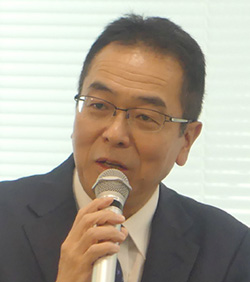
Mr. Kenichi Tamiya, Executive Officer, Pharmaceuticals and Medical Devices Agency
First, the PMDA celebrated the 20th anniversary of its establishment, and with a staff of more than 1,000, the PMDA has started a new stage of its development. He emphasized that each and every officer and employee of the PMDA will face the task of "connecting a healthy living world, together, to tomorrow" (PMDA Purpose) and work towards it.
He then explained the direction of the 5th Mid-Term Plan (FY2024-FY2028), including active contribution to the promotion of practical application from the perspective of regulatory science, strengthening of the ability to make international contributions and proposals, and improvement of the quality and efficiency of business operations. In addition, as new and priority issues to be addressed in FY2024, he mentioned "implementation of consultation and screening that accurately responds to innovation," "support for practical application of pharmaceuticals with high patient needs," "development of an environment that facilitates the start of development and introduction in Japan of innovative pharmaceuticals that have been developed overseas, and the strengthening of information dissemination (measures against drug loss). The report also included specific plans for "strengthening the environment to facilitate the initiation of development and introduction of innovative drugs developed overseas in Japan," "strengthening information dissemination on innovative drugs developed overseas (drug loss prevention)," and "supporting clinical trials in Japan and responding appropriately to real-world data, etc.
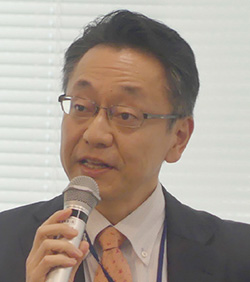
Finally, Mr. Shigeru Nakaji, Chairperson of the newly appointed Drug Evaluation Committee of the JPMA, gave his closing remarks, bringing the two-hour and 40-minute Joint Assembly to a close with approximately 2,000 participants.
(Mr. Toshiharu Sano, Drug Evaluation Committee)