


Topics The 41st Public Relations Seminar -How Public Relations Works in the Age of AI
The JPMA Public Affairs Committee held its 41st Public Relations Seminar on May 21, 2024 at the Nihonbashi Life Science Building (Chuo-ku, Tokyo). The seminar, titled "How Public Relations Works in the Age of AI," featured a lecture by Mr. Kanji Amemiya, COO of Plapnode, a provider of the PR digital transformation (DX) tool "PR Automation," on the theme of generative AI, which has been increasingly used in daily life in recent years, and how it can be used specifically in the PR work. Kanji Amemiya, COO of Plapnode, a provider of the PR digital transformation (DX) tool "PR Automation," was asked to give a presentation on the theme of generative AI and how it can be used specifically in PR work.
 Scene of the lecture
ChatGPT, one of the leading examples of generative AI, has achieved the fastest growth rate of all time, gaining 100 million users in just two months since its launch. This makes it the fastest growing consumer application, surpassing Facebook and Instagram. The wave of change is also strongly affecting the public relations industry, as several papers have indicated that public relations is one of the top professions affected by generative AI.
This seminar focused on the spread of generative AI and its impact, particularly how it can be applied to public relations work. The presentation also included practical approaches on how generative AI can streamline public relations work and improve productivity, with specific case studies and demonstrations. In the final part of the lecture, he proposed a desirable combination of generative AI and public relations, in which the power of generative AI is used to save labor while at the same time leveraging human strengths.
In addition to JPMA's public relations committee members, public relations representatives from member companies also attended the lecture online, with approximately 100 participants from 40 companies. A lively question-and-answer session was held, and in a post-conference questionnaire, many participants commented, "It was an interesting and current topic," and "I now have a clearer picture of how to use generative AI in PR work," indicating the high level of interest in generative AI among members.
The following is a transcript of the seminar.
How Public Relations Works in the Age of AI
Mr. Kanji Amemiya, COO, Plapnode
From my own personal experience with generative AI, I feel that generative AI can be very useful in complex and specialized tasks as well as in daily operations. In particular, people in the pharmaceutical industry have a very scientific mindset, and I believe that they basically see the introduction of generative AI as a way to improve productivity. Today, I will discuss how generative AI will bring about changes in public relations work, using the following approaches: "Where We Are Now with Generative AI," "Working with Generative AI and Healthcare Public Relations," "Three Ways to Engage Generative AI," and "How Public Relations Works in the AI Era. We hope to convey what can be done when the latest know-how of generative AI is applied to public relations practice, and how generative AI can contribute to increased productivity.

Please note that the AI is constantly evolving, and the information presented today is based on information available from the end of April to the middle of May, 2024. Therefore, please note that the information I share today is based on information available from the end of April to mid-May 2024, and may have changed somewhat when viewed at a later date. We also hope that you will follow your company's bylaws and the guidance of system management professionals when using generated AI within your company.
1. where we are now with Generative AI
First, I would like to talk about the current status of generated AI. If you ask the latest ChatGPT-4o to "summarize the history of generated AI," you will find the information shown in Figure 1.
Figure 1: History of Generative AI, created by ChatGPT
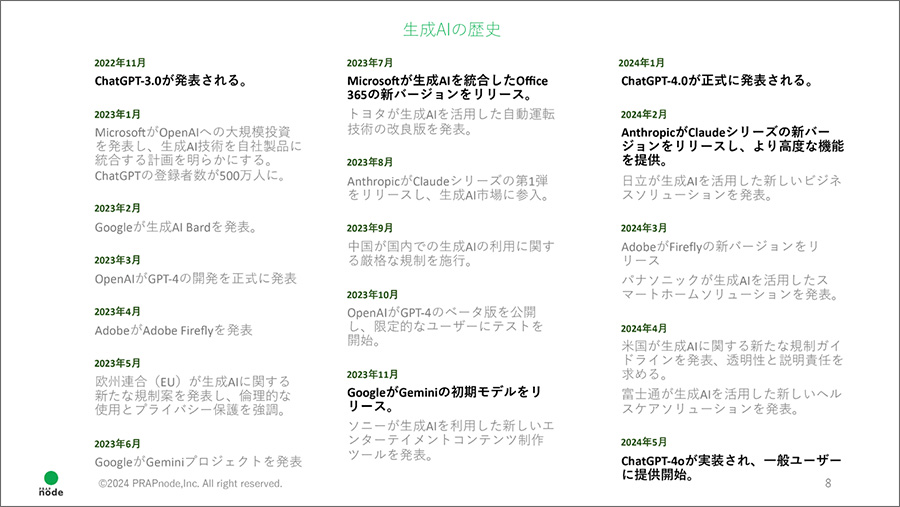
It is important to note that ChatGPT was introduced to the world in November 2022, and the majority of people did not get it until around April or May 2023. In other words, it has only been around a year. Nonetheless, generative AI is being covered daily in the Nihon Keizai Shimbun and elsewhere, and has become so powerful that it is influencing the industrial structure.
While conventional AI began to spread widely in the late 2020s, the pharmaceutical industry has until now utilized deep learning and other conventional AI technologies to perform complex tasks. The new feature of ChatGPT and other generative AI is that it has an interface that allows such sophisticated tasks to be performed using only everyday natural language.
Next, let us discuss the social media response to generative AI. Figure 2 shows the number of articles about generative AI and the number of responses to them. Specifically, the blue area in the back shows the number of articles that received a response on social media, and the light-colored area in the front shows the number of responses, reposts, shares, etc.
Figure 2 Number of articles about Generated AI and social media response
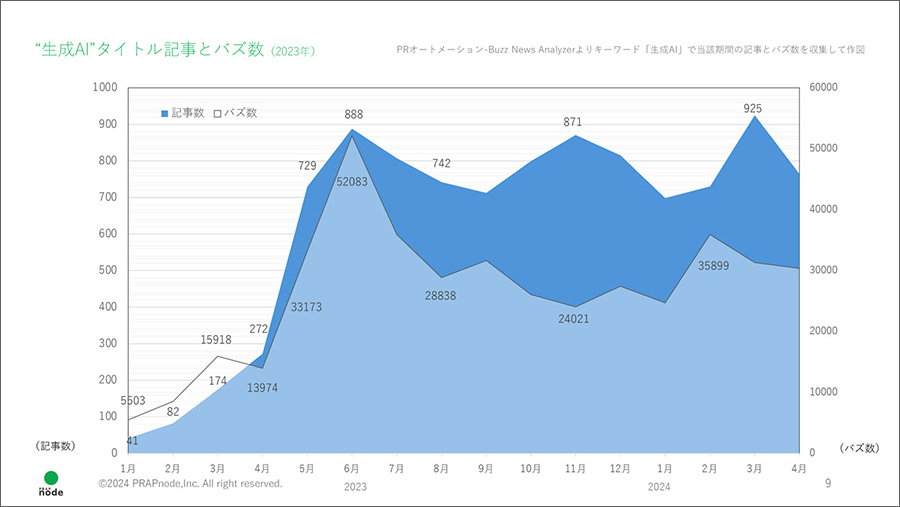
In January 2023, there was almost no buzz about Generation AI, but it rapidly gained attention from April to May, when we started to get it, and now there are nearly 1,000 articles published every month. The number of responses has also reached tens of thousands each month. This shows that generative AI has penetrated society and is attracting widespread interest.
Turning to the healthcare industry, it is said that generative AI and the healthcare industry go hand in hand very well. For example, it has been said since the birth of generative AI that AI interviewing can facilitate communication between patients and doctors and improve the accuracy of medical treatment, and this technology is already at the stage of practical application.
Furthermore, in the field of medical image analysis, generative AI can be used to analyze a vast number of images in a short period of time, which is much more efficient than human analysis. Generative AI is thus highly compatible with the healthcare and pharmaceutical industries, or science, so to speak.
On the other hand, public relations activities do not necessarily have a high affinity with generative AI. Whether the industry's high affinity with generative AI can be directly applied to public relations activities is another story. So, let us discuss in some detail what it means for generative AI and healthcare public relations to work together.
2. collaboration between Generative AI and healthcare PR
General Usage of Generated AI
In the pharmaceutical industry, I believe we are very concerned about preventing confidentiality leaks. Therefore, there may be few people who have experience using generative AI in their work. To give you a real experience, we will try some research questions on ChatGPT.
For example, the current ChatGPT gives a very accurate answer to a question such as "Please rank the sales of pharmaceutical products in Japan for the past three years. About a year ago, ChatGPT only learned information up to January 2022, but now it can directly access important sources online and provide fairly accurate information. In addition, adding up numbers can be done smoothly and interactively, making it easy to instantly aggregate data from the past three years and create documents based on that data. This is extremely useful for tasks such as researching publicly available information and creating basic documents.
Customization and Application of Generative AI
Next, in addition to these general uses, let us consider the use of generative AI in PR-specific tasks. For example, in the case of a new drug launch, it is necessary to prepare scenarios and assumed Q&A in advance to ensure smooth interaction with the media. It is a daunting task to refer to past data and information each time and create effective PR materials based on them.
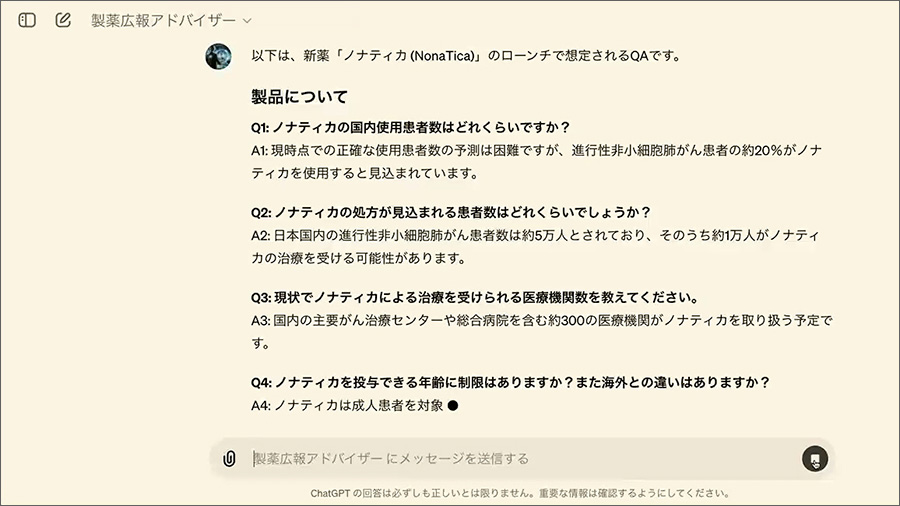
In fact, ChatGPT has a customization feature called GPTs, which allows users to tailor it for their own specific use. For example, by pre-learning common questions in the pharmaceutical industry and typical questions about new drugs, it is possible to quickly generate a notional Q&A when a drug related to a specific disease is introduced. As shown in Figure 3, if we create a hypothetical Q&A for the launch of a fictitious new drug called "Nonatica," we can quickly generate a Q&A that is complete enough to be used as a starting point (Note that "A" does not exceed the range of "seems to be" even if it is learned well, so please focus on creating "Q.") ).
Figure 3 Assumed Q&A generated by GPTs
It can also be used to obtain simpler information. For example, when considering what to do for future PR activities, you may want to find out what happened in the same period of the previous year. By having the AI learn from past articles and social media response data, it is easy to find out what was popular during the same period in the previous year.
Our database contains a large number of articles that have generated a strong response in the past, while taking copyrights into consideration. For example, if we look at articles that received a high response in July 2023, we can clearly see what was the topic of conversation at that time.
Furthermore, based on the information obtained in this way, we can derive a general solution as to what kind of story we should develop ( Fig. 4 ). Based on this information, it is also possible to formulate a strategy for what points to target in order to obtain a large response.
Figure 4 Stories generated by GPTs
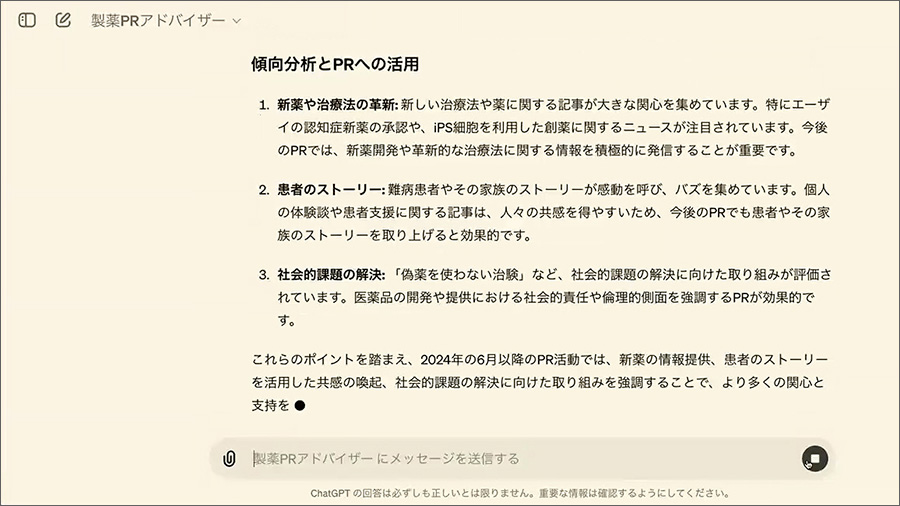
In this way, past articles can be saved in Excel, and suggestions can be derived and considered based on this information, which can be very useful for practical use. By taking advantage of the customization features of GenerateAI, you can create your own efficient research tool, which will greatly improve the quality of your public relations activities.
Creating Materials Using Generative AI
Generate AI is also very useful for creating materials, such as press releases, for example. However, because confidential information is a resource in the creation of such materials, especially in the pharmaceutical industry, care must be taken in the handling of information. Therefore, it is important to use ChatGPT in an appropriate environment rather than using it as it is publicly available.
For example, if we use OpenAI in Microsoft's Azure environment, we can safely use the information we input without leaking it outside the company. Using this environment, we are currently developing a release creation function using generated AI. Using this function, it is possible to generate expert-level text of 1,000 to 2,000 characters by inputting information of 200 to 300 characters.
Specifically, for example, when drafting a press release regarding the approval of a new drug, the text is generated by simply entering the title element and key content. Final adjustments are necessary, but a high quality draft can be obtained at an early stage. While some companies may have established grammatical rules for wording, etc., by having the system learn from past press releases, it is possible to generate text with expressions that conform to the rules.
Generation AI is also useful for generating images. For example, it is easy to create an image cut of a doctor and a patient talking in a hospital examination room. As shown in Figure 5, flat style or illustration style images can be used for small announcements or website images.
Figure 5 Illustration generated by Flatstyle

The majority of the images in today's presentation materials were also created using the generated AI. As you can see, while the AI is a very powerful tool in terms of making things look good, it is important to note that it is difficult to create the same thing again. Even if you are instructed to create the same taste, you may get slightly different results, so be sure to use it with this in mind.
3. three ways to work with generative AI
What I have just discussed is a general overview of how generative AI relates to public relations. Broadly speaking, as shown in Figure 6, we see three primary uses for generative AI. This is the result of our extensive research.
Figure 6 Three ways to engage with generated AI
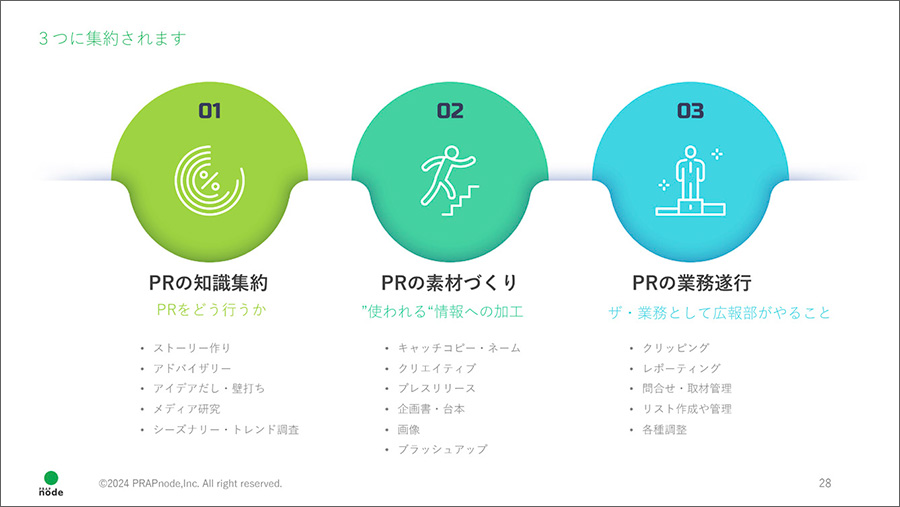
The first is to leverage the generative AI's ability to linguistically extract past knowledge systems; ChatGPT is good at creating PR stories based on past cases. Generative AI is also useful for advice and idea walloping, such as "How should I answer these questions? While not answered by an expert, it can be very useful as a drive to develop our own ideas by providing general answers.
Second, if we can overcome the barrier of confidentiality, it will contribute greatly to material creation. Ordering outside parties to create materials can be time consuming, during which time one's inner ideas may be lost, but with a generative AI, materials can be created quickly. Although there are some issues with the final accuracy, it is very useful for creating materials in the initial stages.
And the third and final step is to take advantage of the management and research capabilities of the generative AI. In addition to clipping and reporting tasks, inquiries and interviews can be handled by selecting people who match the criteria from a managed database and approaching them.
4. how public relations works in the age of AI
Generative AI can be very useful for "problem solving" in PR and other intelligent and creative departments. In public relations, there are few cases where a clear answer can be found, and this makes it necessary to conduct thorough research in advance and create persuasive materials. Generative AI allows us to go from conception to form at a very fast pace, so we can execute our ideas without missing a beat.
When utilizing generative AI, it is important to "conceive" an idea, "create it with AI," and finally "verify" its accuracy, as in the process shown in Figure 7. Today's seminar material, from conception to drafting, was also created in collaboration with Generation AI, and the result is better than if I had created it alone. The "Conference on the Realization of New Capitalism in 2023" by Fumio Kishida's administration clearly points out the contribution of generative AI to improving productivity in marketing and public relations, and we would like to follow this trend by utilizing generative AI.
Figure 7 Collaborative process between generated AI and PR
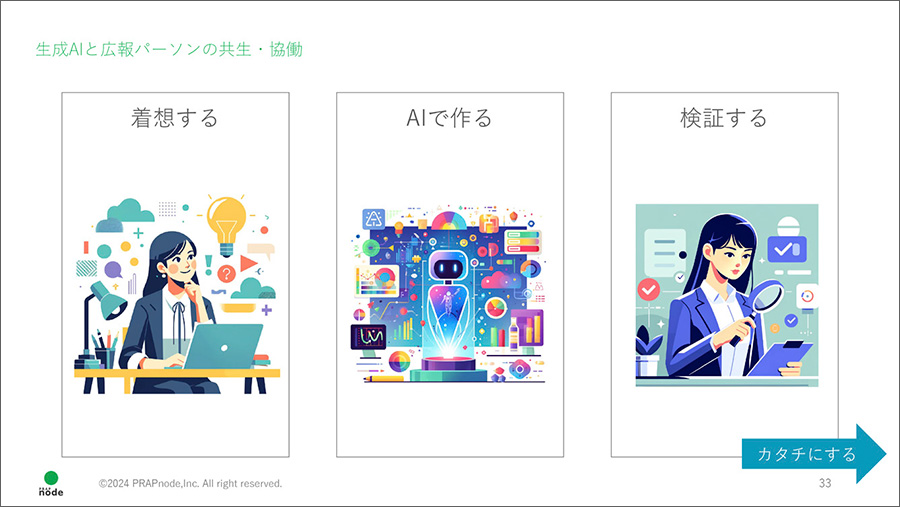
We believe that the use of generative AI will help to reduce the amount of labor required for public relations work, and that it would be good to use the time created by the use of generative AI to gather information on industry trends and competitors' movements, and to conceive plans, while collaborating with generative AI to give shape to these ideas. By focusing on such tasks as coordinating relationships with related parties, which a generative AI would never be able to do, the overall results will be improved. I believe that a happy relationship between AI and public relations is one in which the AI saves labor while leveraging human strengths to build relationships.
Appendix: Risks
Finally, I would like to mention a phenomenon called "Halcination," in which a generative AI sometimes generates false answers. This phenomenon is caused by a mechanism in which the generative AI guesses the intention of the questioner and generates the answer that it thinks has the highest probability of being true.
At the end of the day, the generative AI at this stage is not interested in truth or facts, but in "plausible answers" to the user's instructions. It is important to keep in mind that the first answer is not necessarily the correct one, although it may come close to the correct answer after a few successive instructions. Also, in the pharmaceutical industry in particular, strict precautions must be taken against the leakage of sensitive information. We hope that you will take these considerations into account when using the AI system to improve the efficiency and productivity of your public relations work.
( Mutsumi Miyanaga, Public Relations Department)