


Topics Educational event on pharmaceutical and medical issues "Living with Disease. Living with Hope. Photo Exhibition" was held.
JPMA, with the cooperation of four organizations: the Japanese Society of Clinical Oncology, the Japanese Cancer Association, the Japanese Association for Cancer Therapy, and CancerX, will hold an educational event on pharmaceutical and medical issues, "Living with Disease. Living with Hope. Photograph Exhibition: Unseen Answers, Creating the Future" (hereafter, the exhibition) was held at sorama gallery (Shibuya-ku, Tokyo) from December 12 to 17, 2023, and at Umeda Tsutaya Showroom (Kita-ku, Osaka) from March 25 to 31, 2024.
 Photo exhibition banner
In the society we live in, there are people who face illness every day, believing that one day they will be able to use the medicine they want or find a cure. This photo exhibition, with the cooperation of four organizations, presented portraits and messages of patients and their families, survivors of cancer and those involved in patient support activities, as well as doctors, nurses, pharmacists, and others in various capacities, showing how they live with their illnesses but do not lose hope. The exhibition also featured portraits and messages. The portraits in this exhibition were taken by Harvey Yamaguchi, a photographer who has consistently worked on the theme of "capturing the hope of living" based on his own long experience of suffering from the disease.
Through projects such as this one, JPMA hopes to encourage awareness of pharmaceutical and medical issues among the many people who feel that they themselves are not currently affected, and to promote change from indifference to interest and from lack of understanding to understanding. The JPMA website is also showing the works of this photo exhibition.
Photography exhibition introduction page: https://www.jpma.or.jp/information/public_affairs/pr/2023/photo/index.html
 Exhibition in Tokyo
 Exhibition in Osaka
In addition to the portraits, Explanation Panels on unmet medical needs and new drug development efforts were set up at the exhibition venue to provide visitors with information on the pharmaceutical industry.
 Explanation panel
On December 12, the first day of the Tokyo exhibition, a media interview session was held. Many reporters attended the event, which led to more than 100 media exposures, including news releases announcing the event. We believe that this was a good opportunity to let many people know about the event.
A questionnaire conducted at the exhibition showed that 95.3% of visitors were very satisfied with the exhibition ("satisfied" and "somewhat satisfied"), and 93.1% said that their interest in drug discovery had "increased" or "somewhat increased" compared to before they visited the exhibition. In addition, we received many comments and thoughts from visitors, including the following messages in the free description.
| • | I was moved by the gazes of those who are living with life. |
| • | I was able to learn more from the thoughts of those who are involved in various aspects of disease, including those who support disease and those who are fighting against it. |
| • | It was an opportunity for me to learn that there are still many things I do not know about, such as drug discovery and drug lag. |
In response to the positive response to the Tokyo exhibition, the Osaka exhibition, the second of its kind, will feature a visitor-participation display board on which visitors are asked to place gerbera (gerbera) stickers, the flower that means "hope," on a board to complete the word "HOPE. The exhibition was also displayed near the JR Osaka Station and Hankyu Umeda Station, so that as many people as possible could view the portraits, including those on the posters.
 Participatory display board
 Display board photographed on the last day of the exhibition
 Outdoor advertisement (taken near Hankyu Umeda Station)
During the Osaka exhibition, held from March 25 to 31, the number of visitors exceeded that of the Tokyo exhibition, with approximately 1,200 people coming to see the exhibition. The opening presentation was held on March 25, the first day of the Osaka exhibition, with speakers including Tsuyoshi Takahashi of Osaka University Graduate School, Yuichiro Tanijima of Dakara Cosocreative, and photographer Harvey Yamaguchi, all of whom are active in Osaka and cooperate with this photo exhibition, as well as JPMA Chairman Hiroaki Ueno. The day's topics of discussion included issues and challenges in the pharmaceutical and medical fields from the standpoints of patients, healthcare professionals, and pharmaceutical companies, as well as episodes from the photo shoot and thoughts for the future.
The opening presentation was covered by MBS TV news, Sankei Shimbun, and Yahoo! News, leading to approximately 200 media exposures, including news releases announcing the event.
Below is a video of the opening presentation held on March 25.
March 25, "Living with Disease. Living with Hope. Photo Exhibition" Opening Presentation
 From left: Mr. Harvey Yamaguchi, Mr. Tsuyoshi Takahashi, Mr. Yuichiro Tanishima, and Chairman Hiroaki Ueno
JPMA Chairman Hiroaki Ueno
This photo exhibition was planned to let many people know the thoughts and feelings of patients facing various diseases and medical professionals involved in their treatment, in order to create a world of hope. Although pharmaceuticals have contributed to the treatment of diseases in the past, there are still many diseases for which no pharmaceuticals exist yet. We, who create and provide new medicines, believe that good medicines can only be created with a good understanding of the thoughts of patients and medical professionals involved in their treatment. Through the expressions of patients and healthcare professionals in this exhibition, we hope to share with you how we continue to find hope while living with illness.
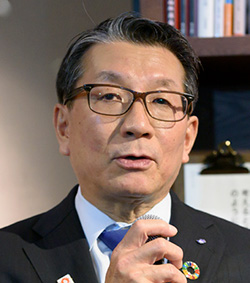
Dr. Tsuyoshi Takahashi, Osaka University Graduate School of Medicine, Center for Medical Education
As a gastroenterological surgeon, I mainly deal with cancer patients at hospitals. My specialty is rare cancers, and I also assist in the development of drugs for rare cancers. I wanted to cooperate with this photo exhibition to let people know about the challenges of drugs for rare cancers. I hope you will enjoy the wonderful photographs by photographer Harvey.
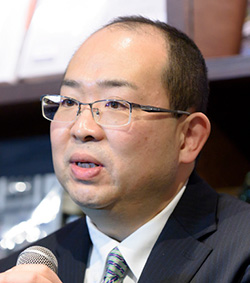
Mr. Yuichiro Tanijima, Founder and Sponsor of Dakara Cosocreate / Owner, Karakuri Lab.
I participated in this exhibition as a patient who is waiting for the development of new therapeutic drugs. I am managing Dakara Koso Create, a project to explore and give shape to what we can do because we are cancer survivors. I was also involved in the "Fourth Basic Plan for the Promotion of Cancer Control" and the "10-Year Strategy for Cancer Research" as a member of the Ministry of Health, Labour and Welfare, and drug loss was a major issue at that time as well. I am pleased to be involved in this project with my doctor, Dr. Takahashi, to educate society about unmet medical needs, including drug loss, through the unprecedented means of photography.
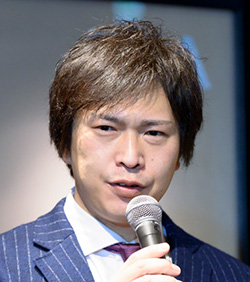
Photographer Mr. Harvey Yamaguchi
I was diagnosed with caries when I was two and a half months old and wore a corset for over a decade, and at the end of my teens, a doctor told me, "You can take the corset off now. I felt hope for life for the first time when the doctor told me that I could take off the corset and live as long as I did not do any strenuous exercise. For patients, a doctor's smile makes them feel better. That is why I requested smiles from all the subjects in this photo shoot. Of course, I imagined what patients would think about having their smiling faces photographed. However, I realize from my own experience as a patient for a long time that seeing someone else's smile can make someone else feel like "I will live again tomorrow. When I release the shutter, I think of the subject's happiness for tomorrow. I believe that this will give good vibrations to my subjects, creating a virtuous cycle that will result in good expressions. Through this exhibition, I hope to convey to everyone the deeper thoughts of patients, doctors, and others in their respective positions.
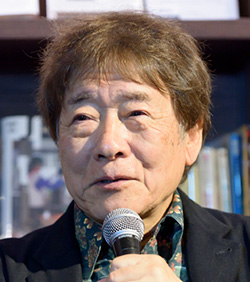
Talk Session
Even with the development of medical care, there are still "unmet medical needs" such as lack of treatments, lack of effective drugs, and the burden of treatment, as well as "drug lag/drug loss," in which drugs approved overseas are not approved in Japan or are not developed in Japan. The Pharmaceutical Manufacturers Association of Japan (PMAJ) is working to address these issues. JPMA hopes to increase the number of people who understand these issues by communicating them to the world at large, with the aim of eliminating them.
The participants in this photo exhibition included various people who are active in the medical field, actual patients, and those who are involved in activities to support patients and their families.
 Talk session
Takahashi: In Japan, treatments for major cancers, including the five major types, have been established, but treatments for rare cancers, for which there are few patients, have not yet been established. GIST (gastrointestinal stromal tumor), which is the disease I am working on, has only one or two patients in 100,000. The challenge is that drugs approved in Europe and the United States have not yet entered Japan. I am very grateful that you have turned your attention to the theme of this year's conference, "Unmet Medical Needs" and "Drug Lag/Drug Loss.
Mr. Tanijima I have been a GIST patient for 12 years. It is difficult to cure and I am still waiting for a cure. Based on this experience, I am working on the theme of "turning my cancer experience into new value and applying it to society. Specifically, we are producing products and programs such as creating SNS stamps of words that cancer survivors were happy to hear or were supported by, and running a social experimental café bar with the theme of talking about cancer in a casual manner. With advances in medicine, cancer treatment and daily life have become compatible. As a result, the challenges of cancer have become something that exists in daily life and in society. When it comes to social issues, it is difficult to be solved only by those involved and specialists, and it is important to get various people in society involved, and we believe that achieving this is a challenge.
We asked Mr. Yamaguchi, the photographer, what thoughts he had in mind when taking the photographs for this project.
Mr. Yamaguchi: For the patients, I was able to approach the shoot with empathy based on my own experience as a patient. As for the medical professionals, their job is to save lives. I wanted to express the interestingness, kindness, and big heart of people who help others in my photographs. It is my wish to capture the best part of the person at that moment.
Finally, I would like to leave a message for those who are facing illness from various perspectives and for those who will be visiting the exhibition.
Mr. Yamaguchi explained, "Everyone has the potential to get a disease. Even if you carry the disease, it is not the end of the story. I would like you to see the interesting images of people who are doing wonderful activities at the photo exhibition." Mr. Takahashi commented, "My photo was taken when I was instructed to show the expression on my face when I tell my family and patients that my surgery was a success. Since I am not usually aware of it, I realized once again that I have this look on my face. They made a wonderful picture," he said, sharing an episode from the photo shoot.
Mr. Tanijima also commented from his perspective as a patient, "At first, I was critical of having my smiling face photographed. However, this photo exhibition is not the kind of thing that consumes patients' smiles as emotional content. Mr. Harvey takes the photos because he wishes them to be happy, and we have a relationship where we wish for each other's happiness from the photos. I hope that this exhibition will be an opportunity for visitors to learn more about the issues of medicine and medical care, and to get involved.
 Chairman Hiroaki Ueno and Mr. Harvey Yamaguchi
In his closing remarks, JPMA Chairman Ueno said, "Even when we are ill, we must not forget to hope for the future. I felt once again that the most important thing is for the world and society as a whole to work together for this purpose. I empathize with the thoughts of the medical professionals who treat patients every day, and as a pharmaceutical company, we will continue to contribute to make this world a better place.
( Takafumi Adachi, Director of Public Relations)