


Topics Joint Conference on Global Health 2023" was held. Co-sponsored Symposium on "Drug Resistance (AMR) as a Global Health Challenge.
The "Joint Convention on Global Health 2023" was held at the Hongo Campus of the University of Tokyo (Bunkyo-ku, Tokyo) from November 24 to 26, 2023. This time, the Global Health Subcommittee of the JPMA International Affairs Committee co-hosted a symposium on "Drug Resistance (AMR) as a Global Health Issue" to provide participants with a deeper understanding of the current status and challenges of AMR.
Opening Remarks
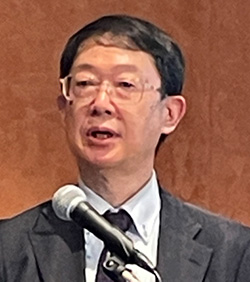
Dr. Hiroshi Yotsuyanagi, Professor, Division of Infectious Diseases, Center for Advanced Medical Research, Institute of Medical Science, University of Tokyo
On the occasion of holding this joint symposium, he introduced the reason for taking up AMR as a theme at the Joint Conference on Global Health 2023, which was planned jointly with the JPMA for the purpose of sharing information and discussing AMR issues at this forum.
AMR is a very important issue in global health and is likely to become the next pandemic, as evidenced by the formulation of the "Action Plan for Drug Resistance (AMR) Countermeasures" in Japan. The World Health Organization (WHO) has listed AMR as one of the 10 threats to global health, and GAVI (Gavi, The Vaccine Alliance) has announced that more patients are expected to die from AMR than from HIV/AIDS in 2022. The presentation will focus on the current status of AMR and its impact on the lives of people living with HIV/AIDS.
In fact, a study published in the medical journal "The Lancet" in 2022 reveals what kind of infections caused by resistant bacteria are killing people in issues such as pneumonia and bloodstream infections.
He stated that One Health as it relates to the SDGs is an important keyword at the Joint Conference on Global Health, and that it is necessary to think holistically, taking a comprehensive view of all living organisms on earth, the environment, and microorganisms in the environment.
Lecture 1
AMR as a Global Health Issue
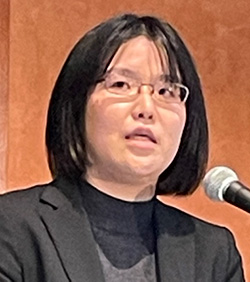
Dr. Yui Kono, Manager, Japan Health Policy Organization (JHPO)
In this lecture, he gave an overview of AMR, the reasons why AMR has been widely taken up by the international community as a global health issue, the current situation of AMR expansion in Japan, and the structural issues of the antimicrobial market and the importance of restructuring, including incentive systems.
One of the reasons why AMR occurs is that the balance of power between antimicrobial agents and bacteria is reversed, and AMR is a serious problem because antimicrobial agents are used in all aspects of medical care and support the foundation of today's safe and secure medical care, and if they become ineffective, ordinary medical care will cease to exist. Therefore, the ineffectiveness of antimicrobials will lead to the loss of normal medical care. Many lives have already been lost due to drug-resistant bacteria, and including AMR-related deaths, it is estimated that 4.95 million people died annually worldwide in 2019.
As billions of people move across national borders every year, there is a risk of the spread of AMR as well as new coronaviruses. In fact, surveys have shown that there is a steady increase in the number of difficult-to-treat resistant bacteria in Japan, which are thought to have been imported from overseas.
One of the possible measures against AMR is to once again reverse the balance of power between antimicrobial agents and bacteria. However, the number of companies developing new antimicrobial agents has drastically decreased since 1990 ( Fig. 1 ), and it is clear that a limited number of drugs are difficult to obtain even in developed countries in some countries.
Fig. 1 Discovery of novel strains of antimicrobials has stopped since the 1990s

This is due to the fact that the market for antimicrobials requires proper use and that prices are set low. Currently, the issue of antimicrobial agents is being discussed in international forums because it is common across countries.
The policy proposal "Establishment of a Sustainable Innovation Ecosystem for Antimicrobial R&D" submitted by the Health Policy Institute of Japan (HGPI), a non-profit organization, together with overseas organizations, has three main points: (1) expansion of stakeholders to invest in restructuring the antimicrobial market, (2) introduction of pull-type incentives (2) introduction of pull-type incentives, and (3) reflection of the voices of patients and other stakeholders in policy formation), with pull-type incentives being one of the specific elements for improving the market structure ( Fig. 2 ). Since antimicrobial agents need to be produced in a stable manner over the long term, continuous support, evaluation, and improvement of policies are also expected.
Fig. 2 Policy recommendation "Establishment of a sustainable innovation ecosystem for antimicrobial R&D"

It is a fact that the number of countries that can create antimicrobial agents is extremely limited. Therefore, Japan, with its drug discovery capabilities, can contribute to those who are suffering somewhere on earth by building a sustainable innovation ecosystem.
Lecture 2
AMR measures in the Japanese government - from the perspective of global health
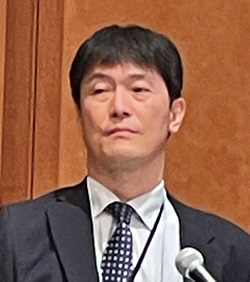
Mr. Eiji Kusaka, International Health and Welfare Negotiator, Minister's Secretariat, Ministry of Health, Labour and Welfare
In this lecture, we will introduce the "Action Plan to Combat Drug Resistance (AMR) (2023-2027)," discuss AMR countermeasures including collaboration with international organizations at the G7 Hiroshima Summit 2023, and discuss the development of international cooperation to achieve the WHO Global Action Plan and Japan's leadership in international contributions. He also discussed the development of international cooperation to achieve the WHO Global Action Plan, and the relevance of Japan's leadership in international contributions, especially in relation to the UN High-Level Meeting on AMR scheduled for 2024.
Based on the Global Action Plan adopted by the WHO Assembly in 2015, action plans were also developed in each country, and in Japan, the Action Plan for AMR Control (2016-2020) was published in 2016. In addition to the five pillars of the Global Action Plan, Japan has added "international cooperation" as a unique Japanese content. 2023 will see the release of the updated Action Plan for AMR Control (2023-2027), the second version of which will be published in 2023.
At the G7 Hiroshima Summit 2023, AMR countermeasures were taken up as an important issue not only at the Health Ministers' Meeting, the Climate, Energy, and Environment Ministers' Meeting, and the Agriculture Ministers' Meeting, but also at the Summit Meeting. The importance of a framework for future pandemic preparedness, particularly the promotion of universal health coverage (UHC) in each country, ensuring access to medicines, promoting innovation, and introducing pull-type incentives, was discussed, and it was reaffirmed that each country should promote One Health across sectors with One Health in mind. The importance of promoting universal health coverage (UHC) in each country, ensuring access to medicines, promoting innovation, and introducing pull incentives were discussed. The results were reflected in the communiqué, including the summit meeting ( Figure 3 ), and led to outcomes that will increase momentum toward the 2024 UN High-Level Meeting on AMR.
Fig. 3 Description of AMR in communiqués of the G7 (Japan) meetings in 2023 (4)

Several recent international conferences on AMR were attended by experts on AMR and One Health from various countries and regions, with Japan also participating locally or online ( Figure 4 ). The G7 High-Level Experts Meeting on One Health shared various approaches and reported on their activities, and the G7 High-Level Experts Meeting on One Health produced results in the form of a "G7 common understanding of the One Health approach.
Fig. 4 AMR-related international conferences held or attended in recent years

In the Q&A session, it was pointed out that developing countries are lagging behind in the development of laws and regulations to combat AMR, and common issues with UHC, such as inspection capacity and legislation, were raised, particularly in the area of monitoring proper use of drugs. It was noted that a lot of funds and time are needed for AMR countermeasures, and it was introduced that Japan is providing continuous support for AMR countermeasures.
Lecture 3
Efforts of the pharmaceutical industry to combat AMR
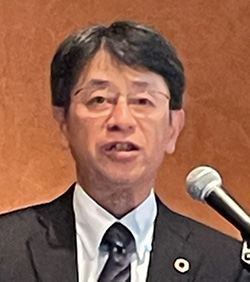
Mr. Yasunori Tawaraki, Member, AMR Advocacy Task Force, International Affairs Committee, JPMA
In this lecture, he talked about the sharing of issues related to AMR and the efforts of the industry for drug discovery in the field of infectious diseases, including the activities of the AMR Action Fund.
The government's "Action Plan for Drug Resistance (AMR) (2023-2027)" has six pillars, and JPMA's efforts in public awareness and education, proper use of anti-microbial agents, research and development, and drug discovery were introduced.
The results of the public survey showed that 40% of parents want their children to take antimicrobials when they have a "cold," and it was reported that there is a lack of understanding about the ineffectiveness of antimicrobials against viruses. The survey also revealed that 75% of the public is unaware of the drug lag/drug loss issue. In order to address these issues, JPMA is working to promote correct understanding of AMR through public lectures, posters, and videos aimed at educating the public about AMR.
Next, he explained that the market mechanism of antimicrobial agents poses a significant challenge to the launch of new antimicrobial agents ( Fig. 5 ).
Fig. 5 Antibacterial drugs are Market mechanism is an issue, and it is difficult to create new antimicrobial agents

Even if new antimicrobial agents are discovered, their use is limited to prevent the development of new resistant strains of bacteria, and profitability cannot be maintained, resulting in a significant decrease in the number of companies engaged in antimicrobial research and development. To solve this problem, the introduction of pull-type incentives to motivate R&D by increasing the predictability of profits after the product is launched and push-type incentives to encourage R&D has been proposed. As a move by the pharmaceutical industry itself, the AMR Action Fund, established in 2020 with the participation of more than 20 global pharmaceutical companies, was introduced. The fund will financially support bio-venture companies working on research and development of new antimicrobial agents, with the goal of bringing two to four new antimicrobial agents to market by 2030. He also touched on pull-type incentives that governments around the world are considering introducing, and introduced that systems have already been introduced in the United Kingdom and Sweden. In Japan, too, a project to support the securing of antimicrobial agents has been initiated, but he pointed out that it may not yet be sufficient in terms of scale to solve the issues needed to promote investment in antimicrobial agent R&D. In addition, he explained collaborative efforts to promote research and development of antimicrobials, such as industry-academia-government partnerships and company-led consortiums to promote drug discovery.
Finally, he stated that it is important for industry, academia, and government to work together to prepare for the coming threat of AMR, and that JPMA will continue to play a role in resolving this issue (Fig. 6).
Fig. 6 Our goal

Conclusion
(Fig. 6) At this joint symposium held at the Joint Conference on Global Health 2023, the industry, government, and academia introduced their respective approaches to AMR. The importance of countermeasures against AMR, which has been called a silent pandemic, must be persistently emphasized in the future.
JPMA continues to conduct public awareness activities on AMR countermeasures and to advocate for pull-type incentives and other measures to promote investment in research and development of antimicrobial agents. Research and development of antimicrobials requires collaboration between industry, academia, and government, and JPMA will continue to work toward solving the AMR problem while incorporating new knowledge.
( Takeshi Watanabe, Kyoko Nakano, and Toshiaki Sakai, Global Health Subcommittee, International Affairs Committee)