


Top News JPMA Media Forum" Held Action Plan for Combating Drug Resistance (AMR) 2023-2027 - Key Points and Future Responses
The Global Health Subcommittee of the International Affairs Committee of the JPMA is working to promote the development of new antimicrobial agents against drug resistance (AMR) in Japan, and to promote public understanding of the various issues and measures related to AMR. On June 28, 2023, the JPMA Media Forum was held at Bellesalle Tokyo Nihonbashi (Chuo-ku, Tokyo). Nineteen media representatives from 15 companies participated in the forum, both on-site and online.
 Scene of the lecture
Introduction
In April 2023, the Cabinet Secretariat (Council of Ministers for International Cooperation to Strengthen Measures against Internationally Threatening Infectious Diseases) announced the Action Plan for Combating Drug Resistance (AMR) (2023-2027). This follows the Action Plan for AMR Countermeasures (2016-2020) announced in 2016.
At the "JPMA Media Forum" held this time, presentations were made by Mr. Tomohiro Onishi, Cabinet Councillor, Office for the Promotion of Countermeasures against Infectious Diseases including New-type Coronavirus, Cabinet Secretariat, who compiled the revision of the Action Plan, Dr. Hiroshi Yotsuyanagi, a leading expert in infectious diseases, Professor, Institute of Medical Science and Research Center for Advanced Medical Science, University of Tokyo, and Dr. Yusuke Ariyoshi, leader of the JPMA's International Affairs Committee's Infectious Diseases Yusuke Ariyoshi, leader of the International Committee on Infectious Diseases of the Pharmaceutical Manufacturers Association of Japan, gave lectures on "Key Points of Revision," "Medical Professionals' Perspective," and "Pharmaceutical Companies' Perspective" of the Action Plan. In the panel discussion that followed, JPMA International Affairs Committee member Yasunori Tawaraki served as facilitator, and a lively debate ensued regarding public awareness and dissemination, one of the Action Plan's goals. Through this forum, the media was able to deepen their understanding of the necessary measures regarding AMR in the future, as well as the need for collaboration among industry, academia, and government, and international cooperation.
Lecture 1
Key Points of the Revised Action Plan for AMR Countermeasures
Mr. Tomohiro Onishi, Deputy Director-General, Cabinet Secretariat, Office for the Promotion of Countermeasures against Infectious Diseases including the New Type IV Coronavirus
Explanation was given on the key points of the revision of the Action Plan for AMR Control released in FY2023 ( Fig. 1 ). It was also pointed out that AMR is recognized as one of the major problems even at the summit level.
Fig. 1 What is the Action Plan for Antimicrobial Resistance (AMR)

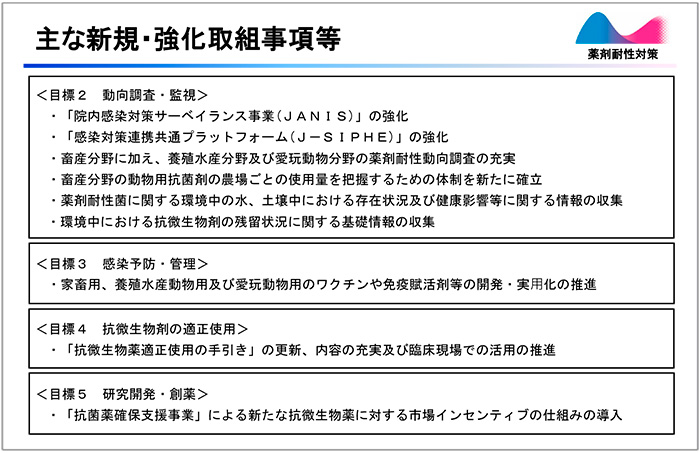
New and strengthened initiatives in the new action plan are as follows ( Figure 2 ). First, in the field of medical care, the "Japan Nosocomial Infection Surveillance Project (JANIS)" and the "Joint Platform for Infection Control (J-SIPHE)" will be strengthened. Third, the "Guide for the Proper Use of Antimicrobial Agents" will be updated to enhance its contents and promote its use in clinical settings. Finally, the introduction of a new market incentive system (pull-type incentive) for anti-microbial agents through the "Antimicrobial Agents Assistance Program" was introduced.
Fig. 2 Major new and strengthened initiatives
Lecture 2
From the viewpoint of healthcare professionals
Dr. Hiroshi Yotsuyanagi, Professor, Research Center for Advanced Medical Science, Institute of Medical Science, University of Tokyo
In this lecture, among the six goals set in the Action Plan, he explained from a broad perspective the prevention and control of infections and the appropriate use of antimicrobial agents, which are particularly relevant to healthcare professionals. In terms of prevention and control, the microflora[1] is shared not only by humans but also by animals and the environment, and in particular, resistant bacteria generated in livestock are introduced into the human body through meat, eggs, dairy products, etc. Therefore, he introduced the need for one-health measures that include not only humans but also animals including livestock and the environment. The need for a "one-health" approach to preventing bacteria from being introduced into the human body through meat, eggs, and dairy products was introduced. It is understood that the balance of the bacterial flora*1 is easily disrupted by the administration of antimicrobial agents, and that it takes time to return to normal ( Figure 3 ).
-
1Microflora, bacterial flora: living microorganisms, bacterial aggregates
Fig. 3 Changes in intestinal microbiota after one-week treatment with broad-spectrum antimicrobial agents

From the viewpoint of proper use of antimicrobial agents, the importance of proper use of antimicrobial agents is still not fully understood, and the "Guide to Proper Use of Antimicrobial Agents" has a flowchart that can be used in the front line of medical treatment to make decisions on the use of antimicrobial agents in a short time and to explain to patients and their families (Fig. 4). ( Fig. 4 ). He also mentioned that new antimicrobial agents will definitely be needed because resistance to antimicrobial agents occurs at a certain frequency even if proper use continues, and that financial support is needed in the field of antimicrobial agents that do not fit into the usual business model, and that each country should cooperate and share the burden of supporting incentives necessary for development as a global issue. The importance of "share" was also mentioned.
Fig. 4 Guide to proper use of antimicrobial agents

Lecture 3
From the viewpoint of pharmaceutical companies
Yusuke Ariyoshi, Leader, Infectious Disease Group, International Affairs Committee, JPMA
In this lecture, he explained about the six areas of goals set in the Action Plan, which are closely related to pharmaceutical companies: R&D, drug discovery promotion, and international cooperation.
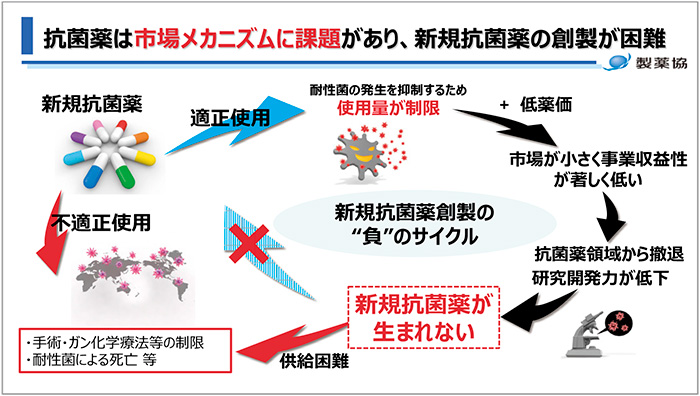
In the area of R&D and drug discovery promotion, he introduced examples of industry-academia-government collaboration, including AMR and other infectious diseases, and explained the JPMA's Policy Proposal 2023, which is an activity of the JPMA as a whole, to demonstrate the importance of industry-academia-government collaboration. He explained the challenges of the market mechanism in the field of antimicrobials and expressed his hope that the pull-type incentive "Support Program for Securing Antimicrobial Drugs" will become a system that satisfies both aspects of proper use and development promotion (Fig. 1). He expressed his hope that the "Support Program for Securing Antimicrobial Agents," a pull incentive, will be considered in order to satisfy both aspects of proper use and development promotion ( Figure 5 ).
Fig. 5 Market mechanisms for antimicrobial agents make it difficult to create new antimicrobial agents
In the area of international cooperation, he introduced the outline of the proposal for the G7 Hiroshima Summit Health Agenda that was presented by the pharmaceutical industry, the AMR Action Fund established by the pharmaceutical industry, and examples of international cooperation efforts by individual companies ( Figure 6 ). He stated that stable drug discovery is essential to fulfilling social responsibility and mission, and that securing R&D funding is a lifeline, and that he hopes to confront this major social issue through collaboration between industry, academia, and government, including institutional design.
Fig. 6 International collaboration: Pharmaceutical company initiatives

Panel Discussion
Facilitator: Mr. Yasunori Tawaraki, Member, International Affairs Committee, JPMA
In this session, the three lecturers discussed the goals of the Action Plan, which are common to industry, academia, and government, namely, public awareness and education. Although there have been various restrictions due to the pandemic of new coronavirus infection (COVID-19), expectations were confirmed that in 2023, events, etc. will be held during the AMR countermeasure promotion month of November, which is designated by the government, and that public understanding will increase through the collaborative efforts of industry, academia, and government.
The importance of medical teams at each medical institution in the field of medicine and the need for academic societies to prepare various guidance documents were also pointed out. In order to further increase the awareness of AMR, it is important to raise awareness of AMR among farmers, livestock producers, and others, while interest in infectious diseases is still high, as it has increased since the COVID-19 outbreak. In order to further increase awareness of AMR, it would be effective to focus on specific segments of the population in addition to the broad base of the population, including farmers, livestock producers, and others, while interest in infectious diseases is still growing as a result of COVID-19. Expectations for the role of the media in disseminating information to the general public were also shared.
In the question-and-answer session, it was confirmed that measures taken only at medical institutions are not sufficient against the background of the fact that the number of resistant bacteria has not necessarily decreased despite the progress in appropriate use of antimicrobial agents, and that it is necessary to take broad measures including those for animals and the environment. The importance of global efforts was also confirmed.
 Panel discussion
Conclusion
The COVID-19 pandemic has raised interest in infectious diseases and promoted understanding of the environment in which appropriate new drugs can be developed and the importance of preparation for such drugs. The Pharmaceutical Manufacturers Association of Japan (PMAJ) has been working with the general public to promote AMR awareness and awareness.
JPMA has been engaged in a wide range of activities aimed at spreading awareness of AMR countermeasures, including among the general public, as well as advocating for the government to strengthen its efforts to address the AMR problem by providing pull-type incentives, which are essential to encourage companies to invest in research and development of antimicrobial agents, and by establishing an international framework system. We have been advocating for the government to strengthen its efforts to address the AMR issue. With the release of the Action Plan, we believe that through this seminar we were able to provide the media with a broad understanding of a wide range of issues, including the background and current status of the AMR problem and the need to develop new antimicrobial agents as the ultimate weapon against infectious diseases. We will continue to promote various activities in cooperation with industry, academia, and government to strengthen our efforts to address this issue from a global and comprehensive perspective.
( Takeshi Watanabe, Toshiaki Sakai, and Kyoko Nakano, Global Health Subcommittee, International Affairs Committee)