


Topics The 39th Public Relations Seminar" Held -What was discussed at the Expert Panel Meeting?
The JPMA Public Affairs Committee held its 39th Public Relations Seminar on July 21, 2023 at Muromachi Mitsui Hall & Conference (Chuo-ku, Tokyo). The theme of this year's seminar was "What was discussed at the Expert Panel on Comprehensive Measures to Achieve a Prompt and Stable Supply of Pharmaceuticals (hereinafter referred to as the "Expert Panel")" whose report was released in June 2023, with Professor Hisao Endo of Gakushuin University, Faculty of Economics, who chaired the Expert Panel, as a lecturer. The seminar was titled "What was discussed at the Expert Panel?
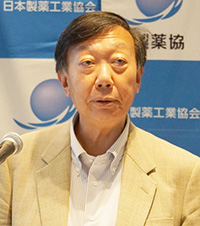
 Scene of the lecture
The Expert Panel is one of the study groups, etc., conducted by the Medical Affairs Bureau of the Ministry of Health, Labour and Welfare, and was held to discuss a wide range of issues, including distribution, the drug pricing system, and examination of the industrial structure, based on current issues, from the perspective of ensuring the early launch of innovative drugs and drugs with high medical needs in Japan and the stable supply of pharmaceutical products in order to maintain and improve Japan's medical standards. The study group was convened for the purpose of discussing the current situation, and from the first meeting in September 2022 to June 2023, a total of 13 meetings have been held with a membership of 12 experts.
In this lecture, Mr. Kato will introduce the data presented at the actual expert panel meetings, the background and process of discussions, and future issues concerning the four points summarized in the expert panel report: "Securing Stable Supply," "Eliminating Drug Lag/Drug Loss," "Strengthening Drug Discovery Capability," and "Efforts Toward Appropriate Pharmaceutical Distribution. Explanations were also given by Hisao Endo, Professor of Gakushuin University's Faculty of Economics, on the data presented at the actual expert panel meetings, the background and process of the discussions, and future issues, etc.
Approximately 200 people from JPMA attended the seminar, including those who participated online. In a questionnaire after the seminar, one participant commented, "It was very informative to hear something that goes between the lines of the report, including future issues," indicating that the seminar was very meaningful for many participants.
The following is a transcript of Mr. Endo's presentation.
What was discussed at the Expert Panel
Professor Hisao Endo, Faculty of Economics, Gakushuin University
The "Expert Group on Comprehensive Measures to Achieve a Rapid and Stable Supply of Pharmaceuticals (hereinafter referred to as the "Expert Group")" issued its report in June 2023. I served as the chairperson of this committee, but I would like to state at the outset that the content of my speech today is based solely on my personal thoughts and opinions, not on my position as chairperson. The background of the discussion was that the problem of "insufficient supply of generics" extended to insufficient supply of new drugs, and the first question was how to think about the structure of the generics industry and drug prices. In addition, the issue of "drug lag/drug loss" was raised in the "prompt" section. Finally, on the issue of "distribution," there was a discussion on whether the allocation of "drug price margin," which is the difference between the official price and the prevailing price, is appropriate from the viewpoint of fairness.
We received candid opinions from companies, industry associations, think tanks, and others on each of the issues, which were then sorted out within the experts' panel. Thus, at the experts' study group, a wide range of discussions were held from the viewpoint of ensuring a stable supply of pharmaceuticals and their early launch in Japan, taking into account the current issues.
1. ensuring stable supply
The first issue is "ensuring a stable supply" ( Figure 1 ). The scandals at generic manufacturers have led to the suspension of shipments of many items. Discussions focused on the need for some measures to address the structural problems caused by generic manufacturers' small-quantity, high-mix production.
Figure 1 Ensuring Stable Supply

Although generics account for a large percentage of the suspension of shipments, brand-name drugs are also affected. Even in the case of limited shipments, we are also investigating whether the reason is the company's own product or whether it was influenced by other companies' products. The survey reveals that, as a practical matter, the company was not able to adequately respond to a sudden increase in demand due to the influence of other companies' products. The data also showed that generics were manufactured even if they were unprofitable.
Next, regarding the price of generics, the data showed that over the 20 years since 2012, the price of internal medicines has fallen by approximately 54%. In terms of manufacturing, the data showed that more than half of the companies were manufacturing generics using more than 99% of their own capacity, a system with no surplus capacity.
As for the marginal profit on drug prices, the emergence of chain pharmacies has led to a difference in profit between the medical institutions and the pharmacies. In addition, there are regional differences in expenses to begin with, but these are not necessarily reflected in the marginal profit, and there was discussion about the fairness of the marginal profit and the fact that too much marginal profit is being taken.
Furthermore, intertwined with the discussion of the form of transaction, there was a discussion of total value transactions. Aggregate price transactions are not an appropriate approach because it means that everything is lumped together and individual drugs are not evaluated. The prevailing price should be determined according to the demand for the drug, but in a total value transaction, they all go down together. Moreover, many new drugs are excluded from the total price transaction, resulting in a rapid decline in the price of generics and a lack of profit for generic manufacturers. There was a discussion regarding these issues.
The government's efforts to promote the use of generics were not limited to raising medical fees and dispensing fees for medical institutions and pharmacies if generics were used, but also included a number of incentives, such as an additional fee for generic name prescriptions to facilitate alternative dispensing. As a result, the industry itself could not keep up with the rapid changes, although the promotion of drug use was realized. And this means that various issues have emerged.
As a direction for countermeasures, there was some discussion about the need to have various types of information, such as production capacity, be made available and reflected in the NHI drug price standards. A new conference body will be established in the future.
2. elimination of drug lag/drug loss
Next was a discussion on "drug lag/drug loss" ( Figure 2 ). The discussion turned to whether the current system is appropriate as a mechanism to promptly introduce excellent products to Japan.
Figure 2 Eliminating Drug Lag/Drug Losses

The additional drug creation allowance was introduced on a trial basis in fiscal 2010, when I was both Chairman of the Central Social Insurance Medical Council (Chuikyo) and Chairman of the Special Committee on Drug Prices, with the aim of eliminating the drug lag. This system was attractive to new drug makers because it maintained the NHI price of new drugs under certain conditions. When the additional drug creation allowance was introduced, it improved access to new drugs and helped reduce the drug lag. However, since then, the Additional Allowance for New Drug Creation has been improved to match the current situation, and I understand that the JPMA and foreign pharmaceutical organizations argue that the drug lag has resurfaced because the two requirements, "individual drug requirements" and "company requirements," were tightened in the 2018 NHI drug price revision in particular, which has made the system less attractive.
Also, at the industry hearings, there were a variety of opinions on how to determine the price of new drugs. Some pointed out that instead of the MHLW setting the initial price as it does now, the price should be determined by experts and that this should be respected, while others suggested that the criteria for evaluating the value of drugs should be expanded and that the value of drugs should be evaluated from various perspectives.
Other issues discussed included market expansion and reassessment. There have long been arguments that patients should be happy to see the market expand through the expansion of drug coverage, and that it is not right for prices to be lowered despite the fact that this has been achieved. I agree with this point, but on the other hand, the reality is that the only way to reduce the price of very expensive drugs that have recently emerged to a level where they can be used is to use recalculation.
In the case of one example of an anticancer drug, it was initially priced very high as an orphan drug, but then clinical trials progressed and coverage was expanded. Therefore, the price was lowered one after another using the method of market expansion and re-calculation. As a result, drug costs did not skyrocket and did not lead to the so-called "drug cost pariah theory. Since the current market expansion reimbursement is effective as such a method, I think the discussion will focus on what should be done in the future while also paying attention to such functions.
Comparing Japan with the U.S. and Europe, the number of unapproved drugs in Japan was higher than in the U.S. and Europe. Some of these drugs have not even been developed in Japan, and since some of them were included in the list of drugs with high medical needs, such as orphan and pediatric drugs, it was said that this could not be ignored.
It was also mentioned that overseas, the focus is on new drugs originating from venture companies. As a discussion that also came up in the new drug creation addition, the report suggests that it may be necessary to remove the company requirement for new drug development by venture companies and make them eligible for the new drug creation addition, etc., since the company requirement evaluates past performance, etc., and does not allow for the evaluation of venture companies.
Regarding the NHI drug pricing system that will improve the attractiveness of the Japanese market, we believe that the conventional way of evaluating low-molecular-weight compounds, especially the system using the cost accounting method, is no longer suitable. In the past, once the price of raw materials was known, a fixed rate was applied based on past results to estimate how much manufacturing and labor costs would be incurred.
However, biopharmaceuticals are made in a completely different way from low-molecular compounds, and require refrigeration during distribution, etc., resulting in a completely different cost structure. In addition, manufacturing costs used to be relatively low compared to development costs, but biopharmaceuticals are manufactured using biological phenomena, so the manufacturing itself also costs a large amount of money. Thus, it is necessary to discuss new evaluation methods for innovative drugs, such as new modalities, in a proper scientific manner.
Next, we would like to discuss strengthening the mechanism for maintaining drug prices during the patent term. The report takes a limited view of "innovative drugs that are particularly necessary for medical treatment.
The pharmaceutical industry is very insistent that prices should be maintained during the patent term, but I do not think that is very reasonable. Even if a product is protected by a patent, the price will naturally fall when a competitor uses a different technology to create a highly competitive product. Maintaining prices and being protected by patents are completely unrelated.
In addition, in foreign countries, if too much profit is taken, there are mechanisms in place to return the profit in various ways, such as official margins, so that even if the price is maintained during the patent term, there is an adjustment for making too much money in other areas. Because of this, the report is limited to the following statement: "For innovative drugs that are medically necessary, strengthening the mechanism for maintaining drug prices should be considered.
Finally, regarding market expansion reimbursement, the report discusses the "review of the concept of similar products" subject to reimbursement. This refers to the co-market expansion reimbursement. When a drug is subject to market expansion reimbursement and its price is lowered, all drugs with similar efficacy are also subject to competitive price reductions.
There was also a suggestion in the discussion that drug costs should be kept at least above the GDP level, but this was treated as "other opinions" in the report and not as a proposal. However, this was treated as "other opinions" in the report and not as a proposal, since the committee members did not necessarily reach a consensus on this issue. The basic stance of the report is that discussions without effectiveness will not get started, so in the process of compiling the report, the content was kept at a relatively high level of effectiveness while including the opinions of the MHLW and other parties.
In discussing the drug lag, we also had discussions on pharmaceutical regulations. For example, there was a discussion on the extent to which clinical trials by Japanese nationals are required when a drug is to be launched in Japan, and how to make it easier for overseas venture companies to develop drugs for rare diseases by making it clear from the early development stage that the drug will be designated as an orphan drug with a high drug price. This will make it easier for overseas venture companies to develop new drugs.
3. strengthening drug discovery capabilities
Another initiative to bring new drugs into Japan quickly is to "strengthen drug discovery capabilities" in Japan ( Figure 3 ). This discussion is from the perspective of industrial policy and drug discovery support to help Japanese companies regain competitiveness as new types of drugs are being developed.
Figure 3 Strengthening Drug Discovery Capabilities

Looking at the world's top 10 drugs in terms of sales, while in 2000 most of them were low-molecular compounds, by 2019 the top 10 have almost completely changed to biopharmaceuticals. In such an environment, strengthening biopharmaceuticals in Japan is a challenge. This means that we should support manufacturing, human resource development, and enable the development of venture companies and start-ups as a drug discovery ecosystem.
In Europe and the U.S., it is often said that venture companies are creating new biopharmaceuticals and other products one after another. In Japan, there are many people who say that this should be realized and that venture companies should be fostered, but they have not been very successful. In the U.S., venture companies are applying for approval and obtaining regulatory approval on their own, but in Japan, only about 2% of venture companies have yet to do so.
There are various arguments as to why this is the case, such as the lack of good human resources for venture companies and the lack of investment of large sums of money from venture capitalists. To be honest, I myself am not convinced that the theory that venture companies, rather than large corporations, can produce good products in Japan is true, but at least there is a trend to actively foster venture companies in Japan.
In terms of business models, there is talk of doing business not with long-term listed products, but with profits during the patent period. It is stated that "Consideration will be given to measures including the use of selective medical treatment and a review of the current measures on NHI prices," but this is a discussion of increasing the co-payment rate for long-term listed products. Since the maximum co-payment rate is set at 30% by a supplementary resolution of the Diet, "selective medical care" is to be used as a method to raise the co-payment rate above that level. If a patient uses a long-term listed product when a generic product is available, the insurance benefit is limited to the price of the generic product, and anything beyond that is "subject to selective care," thereby increasing the co-payment for the long-term listed product. However, this also has a problem: If the co-payment rate for long-term listed drugs is increased, the patient's co-payment amount may be lower for new drugs. As a result, there is a concern that new drugs with higher drug prices will be prescribed one after another, and overall drug costs will rise rather than fall.
As an alternative, there is an argument for changing the benefit rate according to drug efficacy, as in the French system, but it is also pointed out that it is difficult to determine the percentage for any given drug. On the other hand, it is also pointed out that the cost of long-listed drugs does not account for a large portion of total drug costs in Japan compared to other countries, and that suppressing the cost of long-listed drugs would not provide sufficient funds for the evaluation of breakthrough new drugs. In the area of distribution, there is a need for a more comprehensive approach to the division of labor.
4. efforts for appropriate drug distribution
In the area of distribution, the main trading entity has shifted from medical institutions to pharmacies in line with the division of labor ( Fig. 4 ).
Figure 4 Initiatives for Appropriate Drug Distribution

One issue is the rate of discrepancy between the drug price and the transaction value, or the so-called drug price gap. Looking at each target, hospitals and clinics with less than 200 beds, which have the weakest buying power, have the lowest discrepancy rate, which means that they buy pharmaceuticals at a higher price as a result. Naturally, on the other hand, large dispensing pharmacies with strong buying power also have a high discrepancy rate, which raises the question of whether such a situation is desirable or not.
The data also show that, depending on the region, SG&A expenses are generally lower in urban areas and generally higher in rural areas. Considering these factors, rural areas probably have more small pharmacies than large chain pharmacies, which means that the cost of SG&A expenses is higher and the NHI marginal gain is lower. It was discussed whether this is an appropriate way to distribute NHI marginal profits.
In the future, discussions will be held by the Ministry of Health, Labour and Welfare's "Round-table Conference on Improvement of Distribution of Ethical Drugs (NHI)," etc. For example, after a proper investigation and examination of the details of the marginal profit, a mechanism to return profits (e.g., clawback or official margin) like those found in other countries will be considered. I believe that this is a good idea.
5. finally
This expert panel, although it will continue to exist, will effectively come to an end here. From now on, NHI drug prices will be discussed by the Chuikyo, and NHI approval will be discussed by the Pharmaceutical Affairs and Food Sanitation Council (Pharmaceutical Affairs Subcommittee). In addition, discussions on strengthening drug discovery capabilities will be held outside the MHLW, such as in the Cabinet Secretariat. Furthermore, a new committee is scheduled to be established to discuss generics.
I have participated in the Chuikyo and other meetings, and although each meeting has taken a reasonable approach to individual issues, I have sometimes wondered whether it is appropriate when looking at the big picture. In this sense, the fact that we were able to see the whole picture through this expert panel is very meaningful, and I feel that it was a very good experiment. We hope that the report of this study group will be of help in resolving the current issues.
( Takafumi Adachi, Director of Public Relations)