


Top News JPMA Presidents Press Conference Hiroaki Ueno, New President, Delivers a Statement of Position
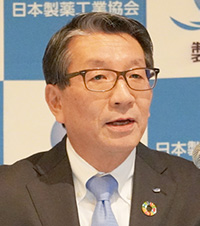
On May 25, 2023, the "JPMA Press Conference" was held in front of Bellesalle Iidabashi Station (Chiyoda-ku, Tokyo). At the press conference, JPMA President Hiroaki Ueno, who was newly elected at the 268th JPMA Assembly held on the same day, delivered a statement of policy and discussed the challenging environment facing the industry and JPMA's future initiatives under the title of "Toward a Nation Driven by Innovation". The press conference was held in a hybrid format of on-site and online, with 29 members of the press from 22 companies in attendance and a lively Q&A session, indicating a high level of interest in the future direction of the pharmaceutical industry. The following is a summary of Chairman Ueno's presentation and the Q&A session.
 Chairman Ueno's press conference
Aiming for a Nation Driven by Innovation
JPMA Chairman Hiroaki Ueno
1. On assuming the position of Chairman
Through the COVID-19 Pandemic
The recent pandemic of novel coronavirus infection (COVID-19) has had an unprecedented impact on the world, with stagnation of social and economic activities, a shortage of medical facilities, and urban lockdowns occurring globally and at the same time. Under such circumstances, messenger RNA (mRNA) vaccines and therapeutics were created and became one of the catalysts for the restoration of daily life, and the usefulness of vaccines and therapeutics in infectious diseases was also reaffirmed once again.
In particular, although mRNA technology had not been put to practical use prior to the coronary disaster, basic research had been conducted continuously, and the pandemic brought the technology to practical use at a stroke. At the same time, various digital technologies have become widespread and implemented in society, enabling new lifestyles and ways of working.
Once again, my experience of the Corona disaster reminds me of the importance of continuing to value and nurture new technologies on a daily basis, as represented by mRNA vaccines, and of working together with industry, academia, and government to speedily put them to practical use when the time comes. In other words, speedy innovation is the key driver for normalization, and to realize this, it is important to be prepared in normal times and to have the ability to act quickly when the time comes.
Role of the Pharmaceutical Industry
We believe that the role of the pharmaceutical industry is to speedily create innovations, deliver them to patients, and contribute to the people of Japan, the nation, and society. The first is to "contribute to the health" of patients and the public. We must continue to create innovative new drugs to address the unmet medical needs that still remain. By delivering these drugs to people not only in Japan but also around the world, we will contribute to the extension of healthy life expectancy of people around the world.
The second is to "contribute to the growth" of the country and society. The pharmaceutical industry is a knowledge-intensive industry that is well suited to Japan, which is not blessed with abundant natural resources. By creating innovative new drugs originating in Japan, the pharmaceutical industry contributes to economic growth through high tax-bearing capacity and the acquisition of foreign currency, and at the same time, we recognize that we play a role in driving science and technology.
Through these two contributions, I believe it is important to combine "strengthening the competitiveness of companies" and "industrial policy as a national strategy" in order for the pharmaceutical industry to fulfill its role as a key industry.
Sense of Crisis in Japan's Pharmaceutical Industry
I would like to talk about some of the crises I feel "strongly" about the Japanese pharmaceutical industry ( Fig. 1 ).
Figure 1 A sense of crisis about Japan's pharmaceutical industry

The first is the slowdown in the creation of new drugs originating in Japan. This is especially true for new modalities. In other words, we may not be able to catch up sufficiently with the progress and diversification of modalities of therapeutic drugs.
The second concern is that the public's access to new drugs is declining. As you know, drug lags and drug losses are expanding. Under such circumstances, I believe that we are becoming an environment where foreign technology, capital, and human resources cannot be attracted.
Third, there is the risk of medical security. We are in a situation where many raw materials for pharmaceuticals, whether new drugs or generics, are dependent on foreign countries. In this situation, a situation has also emerged in which necessary medicines are not in sufficient stable supply.
And the fourth is the social security system that lies behind all of this. In other words, the ceiling on the growth of social security expenses due to the aging of society, and the biased funding of the NHI price revision.
With this sense of crisis, looking at the state of drug discovery innovation in Japan, I feel that the creation of new drugs originating in Japan has slowed down, that there is insufficient evaluation of innovation, and that these factors are creating a vicious cycle. In other words, due to the lack of an adequate evaluation system for innovation, even if good products are created in Japan, they are not sufficiently evaluated, which prevents the next round of R&D investment from being aggressively implemented. It is such a vicious cycle. In addition, if innovation is not sufficiently evaluated in Japan, it is difficult for new drugs from overseas to enter the market, and new drugs from overseas do not reach Japanese patients, which leads to an increase in drug lag/drug loss. In order to break this vicious cycle, we believe that both "strengthening Japan's drug discovery capabilities" and "appropriate evaluation of innovation" are necessary.
Aim
If the vicious cycle can be broken and new drugs from Japan can be delivered to patients continuously and speedily by strengthening Japan's drug discovery capabilities, and if innovation is appropriately evaluated, the results can be quickly reinvested in the next stage of research and development, thereby creating a virtuous cycle.
In addition, new drugs originating overseas will be brought to Japan and delivered to Japanese patients, thereby eliminating drug lag and drug loss. Furthermore, the global distribution of new drugs originating in Japan will contribute to patients around the world, which in turn will lead to opportunities to earn foreign currency and contribute to the Japanese economy. In other words, not only should Japan's drug discovery capabilities be strengthened and innovation be properly evaluated, but these should also be well connected and circulated. This is what the JPMA hopes to achieve in the future.
JPMA's efforts
Strengthen Japan's drug discovery capabilities
As you are all aware, since the era of small molecule drug discovery, in which Japan was strong, advances in science and technology have made it possible to create drugs in new modalities, and the range of drug discovery has been expanding.
Along with this trend, the style of drug discovery has changed dramatically. In other words, as modalities change and diversify, manufacturing methods and evaluation methods are also changing and diversifying. In order to create innovation in such an environment, it is increasingly important to have an ecosystem involving various players, and the key is how well these players work together to create innovation with a sense of speed.
In the new style of drug discovery, it is difficult for a single company to create innovation alone. Especially in new modalities, the speed of technological innovation is so rapid that it is necessary to have a keen eye for elemental technologies and incorporate them into the company from an early stage, and it is also necessary to invest from the early stages of research to manufacturing, requiring major investment decisions at an early stage.
In the conventional drug discovery style based on small molecule drugs, each pharmaceutical company basically had its own core technology of chemical synthesis, and was able to discover, create, and deliver drugs in-house, from research to development and manufacturing. Of course, there were collaborations with academia, start-ups, and contract research organizations (CROs), but these were often on a one-off basis.
However, as the modality has expanded from small molecules to a variety of new modalities, the style of drug discovery has changed and the nature of collaboration has also changed. It is essential to collaborate with highly skilled partners not only in basic research for target discovery, but also in various functions to commercialize new modalities and other products.
The innovations created in this process are then put to practical use by the pharmaceutical companies, approved, and delivered to patients. We believe that there are four important points to realize such a vision.
The first is the practical application of fundamental technologies for drug discovery, the second is the sustainable start-up and development of start-ups, the third is the enhancement of manufacturing capabilities for new modalities, and the fourth is the development of an infrastructure for data utilization (Figure 2). The following is a brief introduction to each of these initiatives.
Figure 2 Four important points for the drug discovery ecosystem

The first is the practical application of basic drug discovery technology. We believe that Japanese academia has a very high basic research capability that can lead to the discovery of drug seeds and the development of basic drug discovery technologies. Unfortunately, however, we recognize that such new basic research in academia is not leading to practical applications. In order to change this situation, we have begun working to establish a mechanism for strong collaboration between researchers in academia and industry, aiming to develop basic technologies for drug discovery from basic research.
The key to this mechanism is not only funding, but also the exchange and circulation of human resources, materials, and technology, and we believe that our active exchange with academia will lead to further expansion and acceleration of the path to practical application.
Second, I would like to talk about start-ups. We recognize that until now there have not been many start-ups in Japan, and there have not been many successful examples of start-ups. In the U.S., many of the seeds for drug discovery come from startups.
We expect that the government will launch a project aimed at strengthening the drug discovery venture ecosystem, which will serve as a foundation for financial and hands-on support for startups. Strengthening the exit strategy of this project is extremely important, and the JPMA would like to cooperate in this effort.
The pharmaceutical industry will support the startups not only in terms of funding but also in terms of knowledge, know-how, and human resources, and promote collaboration based on seeds from an early stage. Thirdly, we will support the development of new modalities.
Third, we will strengthen our manufacturing capabilities for new modalities. In contrast to the small molecule manufacturing technologies that many pharmaceutical companies have had, the number of contract manufacturing organizations (CMOs)/contract drug manufacturing organizations (CDMOs) with expertise in the manufacturing technologies for new modalities is increasing. However, the number and capacity of CMOs and CDMOs are still insufficient, and the government is working to support domestic manufacturing facilities in response to the lack of partners who can manufacture new modalities.
In order to further accelerate these efforts, I feel that it is important to improve both hardware and software. We would like to work toward strengthening domestic manufacturing bases for biopharmaceuticals by utilizing the manufacturing technologies, knowledge, know-how, and human resources of pharmaceutical companies.
The fourth is the development of infrastructure such as health and medical data. As medical care becomes more personalized, health and medical data such as personal medical data, health data, real world data (RWD), and whole genome information will become extremely important.
However, this information is important for each patient and contains a lot of personal privacy information. In order to ensure that patients can provide such information with peace of mind and that those who use it can also use it with peace of mind, I would like the government to take the lead in developing a data infrastructure and a legal system, and to promote comprehensive policies that combine these two elements.
We will certainly complete the four initiatives I have mentioned so far. However, we believe that this alone will not be sufficient. We would like to think together with you about what the "missing piece" is that is necessary for Japan's drug discovery ecosystem, and we would like to implement it.
For example, many people have been discussing the establishment of a drug discovery ecosystem from various perspectives. On the other hand, why have those measures not moved sufficiently to be effective? One of the reasons, I believe, is that we have not been able to focus our efforts on "people. I believe that one of the reasons for this is that we have not yet been able to focus on "people." We need to select people who can think clearly, who have ideas and passion, and send them to companies, and then connect them in an ecosystem, which will create a cycle of knowledge. I would like to discuss such a mechanism with you as one of the missing pieces ( Fig. 3 ).
Figure 3 What is needed for a successful drug discovery ecosystem

Appropriate evaluation of innovation
Drug discovery requires a large amount of R&D investment, and it is important to have a mechanism to circulate the innovations. It is also of utmost importance that the innovations created are properly evaluated.
Looking back at the evolution of the NHI drug price system in Japan, until 2016, the system itself was relatively stable with no major changes, although NHI drug prices were revised every two years. From the standpoint of corporate management, it can be said that predictable management is possible.
However, since 2016, measures that do not properly evaluate innovation have been introduced every year and suddenly. Since these measures were basically accompanied by NHI price reductions and were less predictable, the situation is becoming more difficult for pharmaceutical company management, which requires a medium- to long-term perspective.
Next is the historical and future forecast of the pharmaceutical market in Japan. until 2015, the Japanese pharmaceutical market had been rising moderately every year. However, due to repeated system reforms, the market has stagnated or even declined steadily since then, and external market research indicates that this situation is expected to continue into the future.
On a global scale, however, growth is expected to be in the range of plus 3% to plus 6% annually, and Japan is the only developed country with a low growth rate of minus 2% to plus 1%. From this point of view, there is concern that the attractiveness of the Japanese market has been declining or will continue to decline from a global perspective.
In this environment, the drug lag/drug loss problem in Japan is becoming more serious. The five-year cumulative number of new drugs approved in the U.S. and Europe has been steadily increasing over the past few years. On the other hand, the five-year cumulative number of drugs approved in Europe and the U.S. that are not approved in Japan is gradually increasing. The percentage has increased from 56% in 2016 to 72% by 2020, indicating that the so-called drug lag/drug loss is expanding. Therefore, we are concerned that if the current situation continues, the drug lag/drug loss problem will become even more serious.
In order to solve these problems, we believe that a system to evaluate innovation should be introduced as soon as possible.
First, we call for the introduction of a "Patient Access Promotion and Price Maintenance System" as a new drug price maintenance system. This system would exempt innovative new drugs that are still under patent from revisions based on prevailing market conditions. In addition, we propose a system to re-evaluate the value of innovative new drugs based on evidence obtained after their launch and changes in their position in guidelines.
The second is a new value evaluation system for innovative new drugs. We are proposing a new value evaluation process, flexible selection of similar drugs, and evaluation of various values. We will work toward the realization of these systems.
Our goal under our proposed system is to create a system that is more flexible by maintaining the drug price during the patent term, so that the investment can be recovered in a short period of time and the proceeds can be promptly reinvested in the next stage of R&D. In other words, we are aiming for a fast turnover in drug discovery. In other words, we believe that it will be possible to realize a drug discovery cycle with a fast turnover and speedy delivery of innovative new drugs to patients ( Fig. 4 ).
Figure 4 Accelerating the new drug discovery cycle through appropriate evaluation of innovation

Toward a country where innovation is dynamic
Work to create two mechanisms
Finally, what is necessary to become a country where innovation is dynamic? I would like to share my thoughts on this, firstly, "the creation of a framework to strengthen Japan's drug discovery capabilities" and secondly, "the creation of a framework where innovation is appropriately evaluated" ( Fig. 5 ).
(Fig. 5) JPMA will continue to work hard on these two initiatives, but what I would like to focus on here is the word "creating a framework". Of course, there has been much discussion about strengthening Japan's drug discovery capabilities and appropriately evaluating innovation, but what I mean by "creating a mechanism" is that each measure should not be one-off or temporary. In other words, I believe that "creating a mechanism" can be realized only when each measure functions effectively with continuity and linkage.
Figure 5 Creating two mechanisms for innovation to thrive

Bring innovation from Japan to the world and from the world to Japan
Once again, it is important to note that each of these initiatives must work in tandem to create a virtuous cycle. In other words, by strengthening Japan's drug discovery capabilities, innovative new drugs will be delivered to patients in a speedy manner. The appropriate evaluation of innovations will enable early reinvestment in the next stage of research and development, which in turn will lead to new innovations ( Figure 6 ), creating a virtuous cycle.
Figure 6 Toward a country where innovation thrives Aiming to become a country

In turn, new drugs from Japan will reach the world, contributing to the health of people around the world, and economically, this will lead to Japan's economic growth and strengthen its tax-bearing capacity. Furthermore, the appropriate evaluation of innovations in Japan will create a globally attractive pharmaceutical market, eliminate drug lag and drug loss, and attract technologies, capital, and human resources from abroad to Japan, thereby strengthening Japan's drug discovery capabilities. JPMA is committed to speedily generating and delivering innovations and contributing to the extension of healthy life expectancy, economic growth, and the development of science and technology ( Fig. 7 ).
Figure 7 Bringing innovation from Japan to the world and from the world to Japan

Main Questions and Answers
 Question and answer session
 |
I would like to ask about your perception of the current situation: Compared to 2022, domestic prices and wages will be higher in 2023, and the economy has changed to a growth model. On the other hand, there is pressure to cut budgets due to defense spending, the declining birthrate, and the increasing burden on the public, and drug spending is one of these. |
 |
What will happen to drug spending in the run-up to the 2024 triple revision? With the direction of large budget allocations for defense spending and childcare support, drug costs are entering a critical phase. The JPMA believes that the two most important issues are how to make drug costs more flexible and how to expand overall drug costs. As issues, we would like to discuss how to solve the problems of drug lag/drug loss and stable supply of necessary drugs, as well as how the drug price system should be structured. We also recognize the importance of considering healthcare costs as a whole, which we cannot do alone. |
 |
Regarding the slide with the wave-shaped illustration ( Figure 4 ). In the upper and lower illustrations, the range of investment and payback is larger. Also, the time on the horizontal axis is getting shorter. Is it correct to understand that the amount of investment and recovery is larger, but the time is shorter? |
 |
Exactly. The cycle of business is shortened as new drugs are created, prices are maintained during the patent period, and then given to generics after patent expiration. Relying on business after patent expiration delays the timing of reinvestment, but if the end of the profitable period is known, the timing of the next investment will naturally be earlier. In addition, as modalities change, R&D costs are also increasing, and unless there is a commensurate return on investment, it will not be possible to make the next investment. |
 |
What is the most important thing that pharmaceutical companies must change and what is the most important thing that companies must change? |
 |
We need to improve our own drug discovery capabilities. We cannot win global competition unless we have the ability to compete on a global scale. It may take a few years for the fastest companies and 5 to 10 years for the most basic companies, depending on whether they are averages or individual companies. It is important to develop the ability to compete globally through role-sharing. |
 |
I understand the sense of urgency regarding innovation, but I would like to ask why what the JPMA has been advocating so far has not yet been realized. |
 |
That is the missing piece I spoke of today. There are discussions within the JPMA as to what the bottleneck is and what is lacking. That is what we are trying to find out first. There are several things in terms of R&D, partnerships, systems, drug prices, etc. There are not so many things missing in each one of them. What steps can be taken? We will consider whether it is people, goods, money, or systems. |
 |
Regarding the new coronavirus vaccine. The Corona disaster forced us to rely on imports for vaccines. Japan was said to be behind the curve. Once again, what is the significance of domestically producing the corona vaccine? |
 |
Regardless of the scale or form of production, it is important to continue research and production of vaccines and therapeutic drugs, and I believe that the support of the government will lead to a system in which vaccines can be produced in preparation for a coming pandemic. |
 |
In the case of Japan, since ethical drugs are paid for in kind by public insurance, it is necessary to talk about how to make the situation financially acceptable. I felt that today's discussion was more about positive financial resources spending. If there are parts that protrude, wouldn't it be more logical to propose parts that can be retracted? |
 |
I have been talking about the proposals that I explained today since I was the previous chairman, and I believe that my role is how to realize the proposals. The issue of financial resources is also unavoidable. The patent system will be a very flexible system. We will be discussing this issue, including financial resources. We are reaching a consensus on the main idea. For new drugs, the set of issues will include the drug price structure after the patent expires. |
 |
When do you think a drug price system like the one you explained today will be feasible? You also explained that the Japanese market is not growing, but what is the desired rate of growth? |
 |
There are two aspects: the maintenance of drug prices during the patent period and the pricing of new drugs. The same applies to the pricing of new drugs, which should be done in stages. As for the growth rate, it is not for us to be specific here, but we feel that the growth rate should be such that the Japanese market is considered attractive in comparison with other countries and in light of the soaring prices in Japan. |
 |
The government is working on measures to address the declining birthrate. In the area of pharmaceuticals, how do you plan to tackle pediatric drugs, for which pediatric indications have long been an issue? |
 |
We are aware that there is a drug lag and drug loss in pediatric drugs as well, and that this includes drugs for rare diseases in particular. There is also the issue of drug prices, but we will request the government to make such drugs available to patients in the future in conjunction with pharmaceutical measures. |
(Public Affairs Committee Chairperson: Tatsuya Izumikawa )