


Topics JPMA Media Forum" Held Health and Economy "The World's Focus: The Future of Health Economics Research in Japan's Aging Society"
On May 18, 2023, the JPMA Media Forum entitled "Health and the Economy: The Future of Health Economics Research in Japan's Aging Society," was held at Muromachi Mitsui Hall & Conference (Chuo-ku, Tokyo), featuring Reine Takahisa of Hitotsubashi University, a member of the Study Group on Extending Healthy Life Expectancy and Driving Economic Growth. The event was held at the venue and via webcast. The event was attended by 23 media representatives from 14 companies at the venue and via webcast.
 Scene of the lecture
In this lecture, the speaker explained the results of the "Study and Proposal on the Contribution of the Pharmaceutical Industry to Extending Healthy Life Expectancy and Driving Economic Growth," which was compiled recently, and also discussed the importance of the elderly as active consumers in the super-aging society that Japan and the world will face in the future, which can only be achieved if they maintain their health. --In addition, he also presented data on the analysis of the aspect that the elderly as active consumers can stimulate the productive activities of the working-age population in the super-aging society that Japan and the world will face in the future.
The following is a summary of Mr. Takahisa's presentation.
Health and Economy
The Future of Health Economics Research in Japan's Aging Society
Associate Professor , Graduate School of Economics, Hitotsubashi University
Characteristics of "Aging Economy
Japan is one of the world's leading countries in the aging of its population. Private household final consumption, which accounts for about 60% of GDP, is dominated by consumption by elderly households. Although there are few macroeconomic estimates of trends in consumption expenditures by age group, the elderly currently account for about 30% of total expenditures, and it is expected that they will account for about 40% of total expenditures in the future.

We decided to study the meaning of the economic activities and contributions of the elderly, believing that such consumption activities of the elderly need to be more Explanation from the aspect of health. From the perspective of the health industry, there exists a significant relationship between health and consumer activities, and we believe that by ensuring that people receive drugs and treatments that help them maintain their health, and that they are compliant with their medications and stay healthy, it will not only make their lives happier, but also have the effect of making them more active as consumers. This is a very important factor for the elderly. Potentially, health issues become more important for the elderly, so it is possible that the pharmaceutical industry can contribute to economic activities from this aspect.
Declining birthrate
One factor that will make the economic activities of the elderly more important in the future is the fact that the population of young people is decreasing at a considerable rate. In terms of the country as a whole, the activities of the elderly will become more important, and we need to think about how we can stimulate the productive activities of the young by having the elderly engage in consumption activities in a healthy state, thereby circulating money to the younger population.
Looking at the balance of household assets by age group as published by the Ministry of Economy, Trade and Industry, the total value of assets is the sum of financial assets and housing and residential land, but the balance of financial assets excluding housing and residential land is very high for those in their 60s to 80s. As a percentage, the elderly have about twice as much financial assets as those in their 40s.
Projected Number of Households and Consumption by Age Group
When we look at macroeconomic statistics to see changes in per-household consumption, we find that the consumption of the younger generation has declined significantly over the past 10 years, but the consumption level of the elderly has remained constant, probably due in part to the fact that their financial assets are residential land and housing.
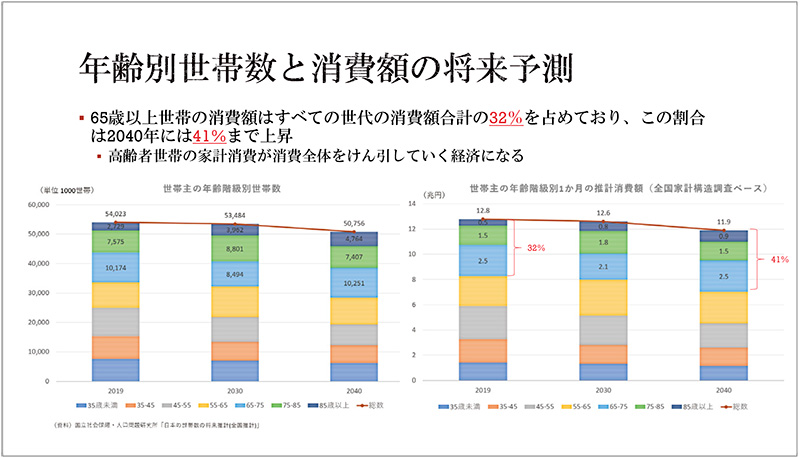
Multiplying these consumption trends by the projected number of households by age group gives us some idea of the future shape of consumption in Japan as a whole. Multiplying the distribution of the number of households by age group by the estimated monthly consumption, we can analyze that as of 2019, about 32% of Japan's total consumption will be by elderly households, that is, households aged 65 or older.
Since macro private household final consumption is about 300 trillion yen, roughly 100 trillion yen is spent by the elderly. Looking at how this proportion will change in the future, it is estimated that the elderly will account for about 41% of households in 2040, and that elderly households will be responsible for a higher proportion of consumption than they are now. Therefore, if more elderly people suffer from poor health and their consumption declines, this will have a considerable impact on overall domestic consumption ( Figure 1 ).
Figure 1 Future Projections of Households and Consumption by Age
Impact of illness on income and labor supply
We believe that the economic contribution of the elderly needs to be examined not only in terms of their inability to work when they are ill, but also in terms of the aspect of their inability to spend money when they are ill as well. Regarding the impact of illness on consumption, it is possible that consumption declines because income declines due to the inability to work due to illness, but for the elderly aged 75-80, income from work is basically not the main source of income, so consumption does not decline as a result of work or income decline. Rather, the marginal utility of consumption may decline due to morbidity, and the sense of satisfaction derived from consumption may also decline with old age. I do not think these aspects have been studied academically.
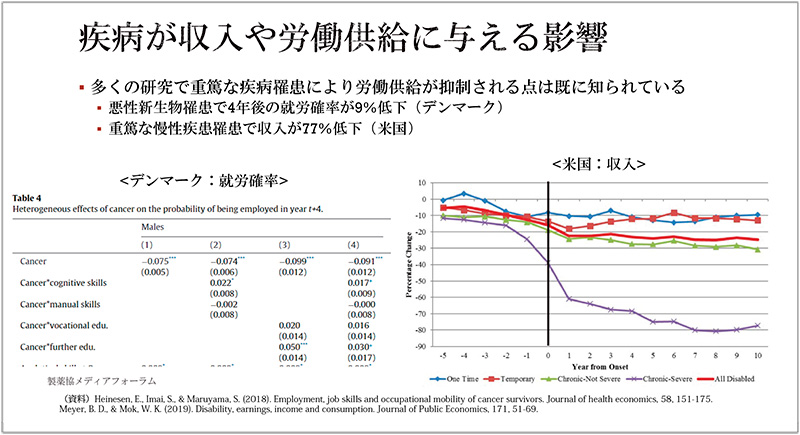
There is already a vast amount of research around the world on the impact of illness on income and labor supply, and one well-known study is a study on how much cancer patients in Denmark are able to work. In Denmark, all receipt data is linked to income information via my number, so we can see how many cancer patients have exited the labor market due to the loss of income via my number. Analysis of this high-quality data shows that about 10% of people with cancer exit the labor market after four years. A U.S. study also compared the incomes of people with a serious chronic disease with those of other people, and found that those with a serious chronic disease also had about a 77% drop in income ( Figure 2 ).
Figure 2 Impact of disease on income and labor supply
What good is wealth without health?
In 2013, Finkelstein of the Massachusetts Institute of Technology published a paper titled "WHAT GOOD IS WEALTH WITHOUT HEALTH?" or, "How good is it to have only money without health?" published a paper titled "How good is it to have only money without health? In an economics diagram, the horizontal axis is "consumption" and the vertical axis is "satisfaction (how much satisfaction is obtained from consumption)," and the graph gradually bows to the right ( Fig. 3 ).
Figure 3 Conceptual diagram of marginal utility of consumption
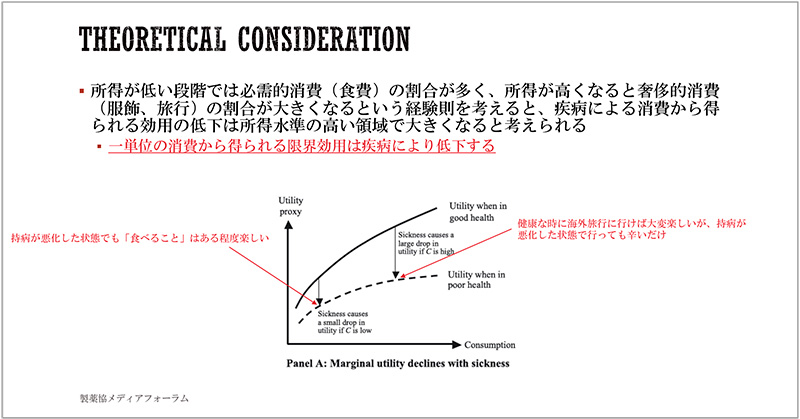
In other words, the initial consumption is very enjoyable, but as you consume additional portions over and over again, your satisfaction level gradually decreases. It is similar to the story of a hamburger: the first bite is delicious, but after three bites, it is no longer satisfying. Using this kind of thinking to explain what exactly it means to be sick is thought of as the effect of lowering this satisfaction curve. In particular, it is important to note how it lowers, and it is thought that it may lower the satisfaction level of marginal consumption at higher consumption levels.
For example, the intuitive explanation for the cost of food is that eating itself does not cease to be enjoyable to some extent, even if one becomes ill. On the other hand, the more extravagant consumption, such as traveling abroad, the more important health becomes. I do not think that many people can enjoy extravagant consumption in an unhealthy manner. The higher the consumption of such economic activities, the more important health becomes. We believe this is an important point.
In fact, in Finkelstein's paper, he compared how much life satisfaction differs between the high and low health statuses in each income bracket. The comparison shows that there does not seem to be much difference in the low-income group, but the high-income group, which has a high proportion of satisfaction with luxuries, shows a very low level of satisfaction.
Analysis using the Japan Social Survey of Age, Living and Health (JSTAR)
Next, we present an analysis of what happens to the elderly in Japan, using one of the best quality data available on tracking individuals in Japan, the Japan Survey of Social Affairs and Health (JSTAR).
The survey was conducted four times in total, every two years from 2007 to 2013, and data was taken in 13 cities throughout Japan. Similar surveys have already been conducted in developed countries, and since this is the Japanese version of those surveys, the data is comparable. We would like to compare this analysis with those of other countries and publish a paper on the subject in the future.
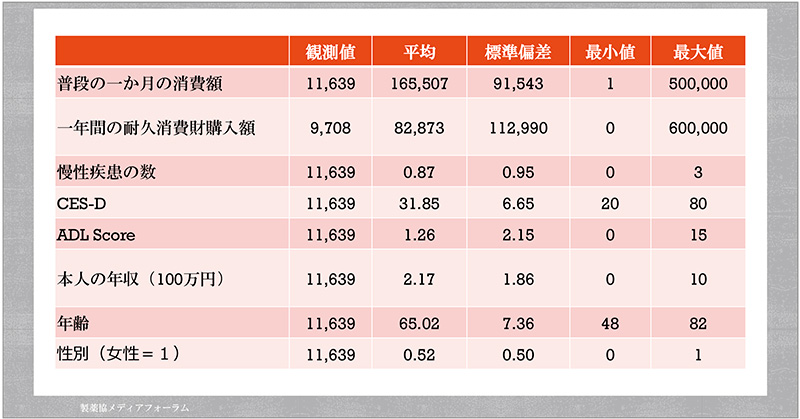
JSTAR is looking into the health status and satisfaction level for each and every observation. The survey asks about the usual monthly consumption. The average monthly consumption is 165,507 yen. The amount of durable consumer goods purchased is also examined. The number of illnesses and which illnesses they suffer from are also examined, and it seems that everyone has at least one illness. The average age of the sample is 65 years old, most of them have an annual income of about 2 million yen, and half of them are women. The diseases examined in JSTAR include heart disease, hypertension, hyperlipidemia, and about 10 other diseases, and one person may suffer from more than one disease. In addition, items related to mental health are also examined in detail at a fairly international level ( Figure 4 ).
Figure 4 JSTAR survey items
Using JSTAR, a simple tabulation of the difference in consumption between those with and without the disease shows that the average consumption of those with the disease is about 20,000 yen per month lower than that of those without the disease. When broken down by income level, low-income earners spend considerably less when they have three coexisting diseases.
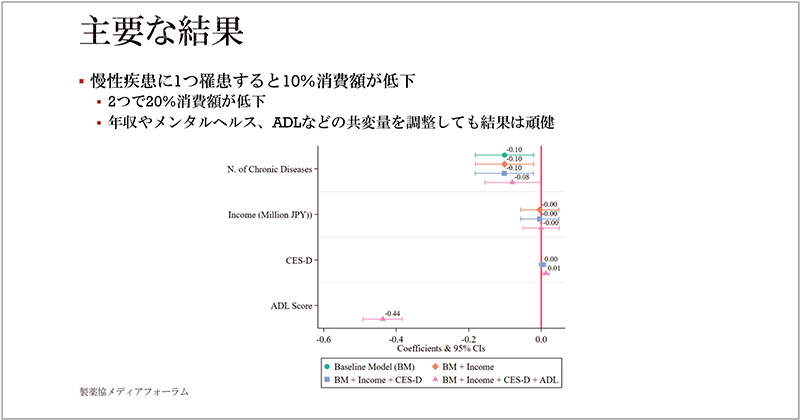
Next, in terms of satisfaction, the percentage of low-income earners who say they are dissatisfied with their current lifestyle increases when they suffer from a disease. Using these data, we investigated how much the amount of consumption is actually affected by suffering from a chronic disease ( Figure 5 ).
The results show that consumption decreases by 10% for each disease. The results show that consumption declines by 10% when a person is afflicted with one disease, which is in line with the results of our previous study, which showed that consumption declines significantly when a person is afflicted with two diseases. Since many elderly people suffer from two or three diseases, it is difficult for them not to get sick at least once, but delaying the onset of illness may have a considerable impact on the macroeconomy.
Figure 5 Impact of suffering from a chronic disease on consumption
Results by disease
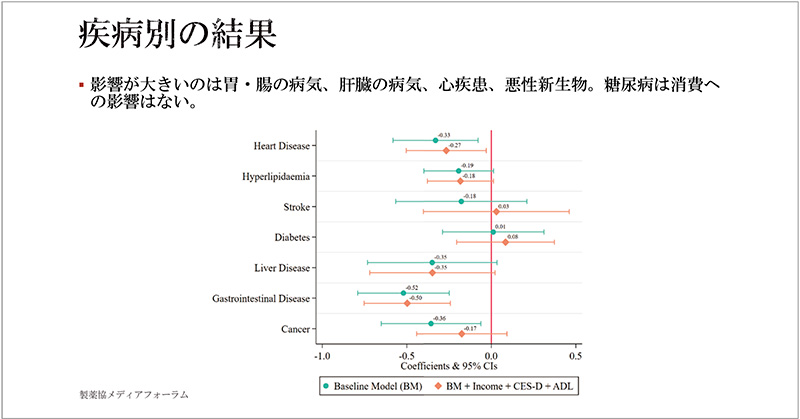
Next, we will discuss which diseases have the greatest impact on consumption. As a result of this study, the effect of what is classified as gastrointestinal diseases is very large minus 0.52, which is about 50% lower. We believe that the data support the idea that such diseases prevent people from leading active lives, since gastrointestinal diseases are probably diseases that have subjective symptoms, such as ulcers. Liver diseases also affected consumption trends considerably when they were afflicted. Next is diabetes, which was estimated and had no particular impact this time, but we believe that there is probably a pattern of people being diagnosed only with no subjective symptoms. Finally, there is the impact of cardiac disease, which seems to be quite significant. The development of such diseases results in a decrease in the willingness to consume for about 30% to 40% of the population ( Figure 6 ).
Figure 6 Results by disease
Impact by number of chronic diseases
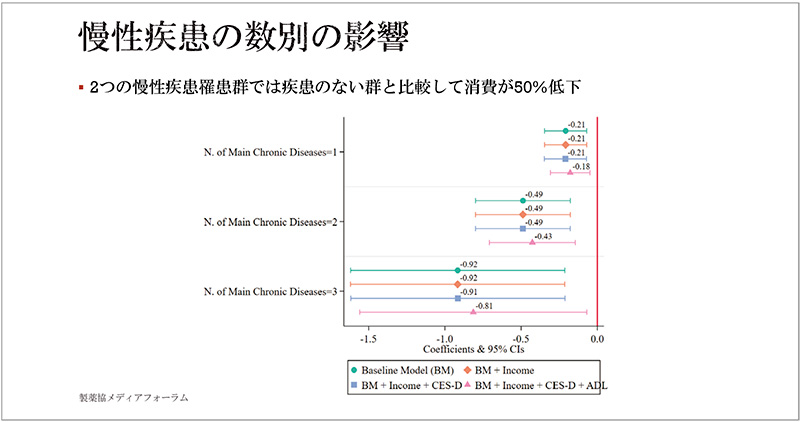
Next, we considered how having multiple chronic diseases relates to consumption. We believe that it is a reality that the elderly are suffering from 3 or 4 diseases at the same time. We calculated how much the impact would change depending on the number of diseases they have. Based on this formulation, the drop in consumption for a person with one disease is roughly 20%; for a person with two diseases, consumption drops by 50%, and for a person with three diseases, consumption drops by 90%, so the drop is quite large. It is clear that as the number of illnesses increases, so does consumption ( Figure 7 ).
Figure 7 Impact by number of chronic diseases
Furthermore, how do drugs contribute to this relationship between health and consumption? For example, the impact on consumption remained about the same for those with and without medication in hyperlipidemia. If the effect on consumption was small and remained the same in the group with medication as in the group without medication, despite the more severe symptoms in those with medication, we believe that it is possible to interpret the effect of the medication as a reduction in the effect of lower consumption. This is still just an interpretation, and I think we need to make sure that it is scientifically correct.
Macroeconomic Implications
Regarding the effect of the diseases introduced, the consumption drops by about 20% for the two diseases, but there is a possibility that the effect is overestimated. The reason is that the average number of illnesses in this study was approximately one, but when we check the number of illnesses in the National Survey of Living Standards and other surveys, the average number of illnesses is two or more. This means that the number of diseases may have been underreported in this study. Even so, the impact on consumption is clearly observed in the graphs, so the impact cannot be ignored. As a rough estimate, we wondered what would be the magnitude of the loss in consumption due to these diseases in the macroeconomy as a whole.
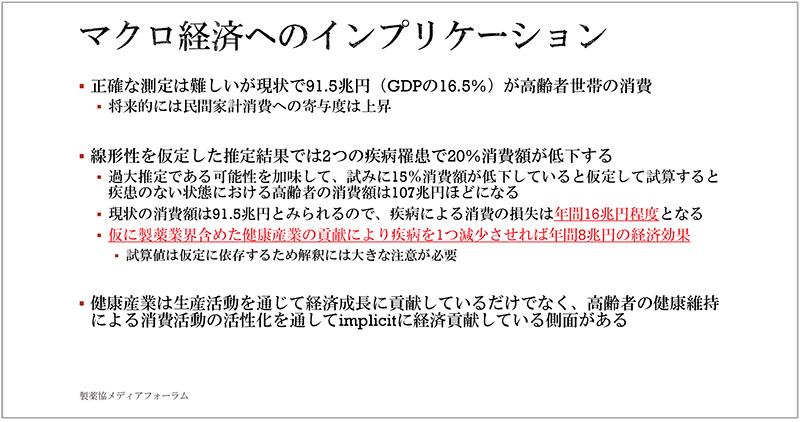
Currently, the consumption of households headed by elderly persons aged 65 and over is estimated to be about 91.5 trillion yen. In the future, about 40% of household consumption will come from elderly households, so the percentage will rise even more. However, based on the estimation results we obtained in this study, which assumed linearity, we concluded that the impact of health on consumption is 20% lower for two illnesses.
If we take into account the possibility that this is a slight overestimation and assume that consumption declines by 15% after contracting two diseases, we can interpret this as follows: Since the consumption of the elderly in the disease-free state was probably about 107 trillion yen, a 15% decline due to disease would be 91 trillion yen in reality, or an annual consumption loss due to disease of about 16 trillion yen. In other words, the consumption loss due to illness is about 16 trillion yen per year.
The current situation is that most people over the age of 75 have two or three illnesses. If medical technology can be developed to reduce one of these diseases, or if not possible, to maintain a quality of life equivalent to that of a disease-free state, an economic effect of about 8 trillion yen per year, half of the 16 trillion yen, can be expected from reducing one disease ( Figure 8 ).
Figure 8 Macroeconomic Implications
The impact on employment is a focus of attention in disease prevention. However, considering the future of Japan, it would be better to maintain good health as much as possible and add up the consumption of each healthy individual, rather than to contribute to the economy by working in the labor market, which would probably be a vision that does not create conflicts between generations.
Even though it is a rough estimate, if we estimate using the best data actually available in Japan, the impact of loss of health status on consumption is still considered to be significant. I believe that it is a real fact that people do not enjoy spending when their health is impaired, and that deaths of people who have saved money but do not spend it will become an increasingly important economic problem in the future.
( Sohei Motoyama, Advocacy Group, General Policy Subcommittee, Pharmaceutical Industrial Policy Committee)