


Topics JPMA Media Forum" Held What to do about Vaccines? -What we can do now for the future
On April 10, 2023, the JPMA Media Forum was held at the Muromachi Mitsui Hall & Conference (Chuo-ku, Tokyo). This year's forum was entitled "What to do about Vaccines? -What we can do now for the future", two lecturers, Mr. Daisuke Inoue, Assistant Director, Office of Counselor for Immunization, Health Bureau, Ministry of Health, Labour and Welfare, and Mr. Haratoshi Kamaharan, Executive Director, Japan Medical Association, gave lectures and answered questions. The event was attended by 33 media representatives from 22 companies at the venue and via webcast.
 Scene of the lecture
The background of this forum is that all generations have become familiar with the threat of infectious diseases after the coronavirus disaster over the past few years, and that various changes in awareness of infectious disease prevention have occurred. The Pharmaceutical Manufacturers Association of Japan (PMAJ) will continue to promote the digitalization concept of vaccination and the significance and value of vaccines for the prevention of infectious diseases.
JPMA will continue to cooperate and collaborate with all parties concerned with vaccines, and will communicate the digitalization concept being considered by the immunization administration, as well as the significance and value of vaccines for the prevention of infectious diseases.
Below are the contents of the lecture.
Subject 1
Digitalization of the Immunization Program
Mr. Daisuke Inoue, Assistant Director, Office of the Counselor for Immunization, Health Bureau, Ministry of Health, Labour and Welfare
Toward Better Immunization
It is historically proven that immunization has made a significant contribution to mankind by preventing the outbreak and spread of infectious diseases, improving the level of public health, and maintaining the health of the population. Most recently, COVID-19 immunization has been effective in preventing serious illnesses, and is considered to be an important medical measure. We would like to introduce the digitalization of immunization programs currently under study at the Ministry of Health, Labour and Welfare for the realization of better immunization.
Promotion of Digitalization of Immunization Business
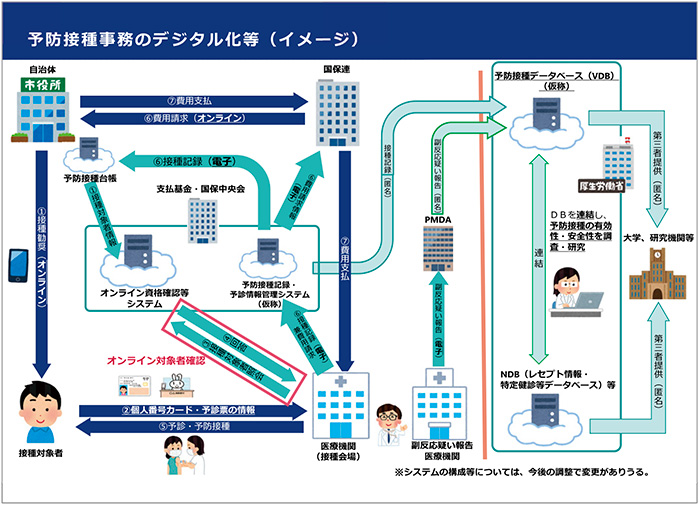
The objectives of promoting the digitalization of the vaccination program ( Fig. 1) are to "improve convenience for the public," "reduce the administrative burden on local governments and medical institutions," and "conduct more accurate vaccination efficacy and safety studies.
(1) Improving efficiency of vaccination administration
In the current vaccination program, local governments, which are the implementing entities, send paper preliminary medical checkup sheets and vaccination tickets to eligible persons. Medical institutions that administer vaccinations use these to confirm eligibility and conduct preliminary examinations, and after the vaccinations, they mail the preliminary checkup sheets to the local governments and punch in the information to charge for the vaccinations. This paper-based operation has created an administrative burden for local governments and medical institutions.
From now on, the My Number Card will be utilized in the immunization business, and the subject confirmation and cost billing, which are done with paper preliminary checkup sheets and vaccination tickets, will be done online. This is intended to streamline the management of vaccination records by local governments and the administrative work related to cost billing and payment by local governments and medical institutions.
(2) Realization of Effective and Efficient Surveys and Research by Establishing a Database
Vaccinations are administered using vaccines that have undergone regulatory review and received approval, but unavoidable adverse reactions, etc. may occur in a certain number of people who receive vaccinations. Although the MHLW is sometimes requested to conduct surveys and research on safety, it is difficult for the MHLW to promptly grasp the vaccination status and conduct surveys on efficacy and safety because local governments manage vaccination records in the current immunization program. Therefore, the MHLW is considering the construction of a database to link vaccination histories and suspected adverse reaction case reports on an individual basis.
First, medical institutions will be able to ascertain the vaccination status based on the vaccination information registered in the Vaccination Record and Preliminary Medical Examination Information Record System (tentative name). Furthermore, an immunization database (tentative name) will be constructed to store collected immunization records and cases of suspected adverse reaction reports in an anonymized format. It is envisioned that these data will be linked to the National Database (NDB) and utilized through a third party for surveys and research on the safety and effectiveness of vaccinations.
Fig. 1 Digitalization of vaccination services (image)
National Medical Information Platform (Future Vision)
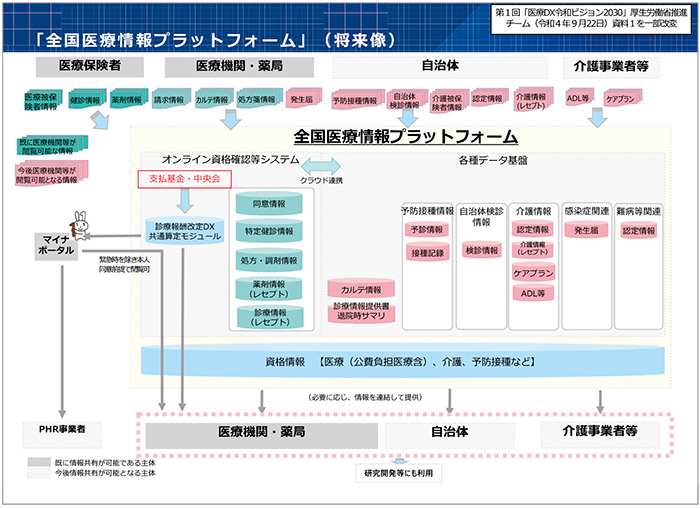
In order to provide better medical care to the public, we are considering expanding the network of online eligibility verification systems and establishing a national medical information platform ( Figure 2 ). In addition to medical fee statements (receipts) and information on specific health checkups, medical information, including immunizations, will be linked to the cloud, and it is envisioned that local governments, etc. will be able to view this information when necessary and utilize it for their projects. This system will enable patients who receive medical examinations with their my number card to share their own information with their doctors with their consent.
Fig. 2 National Medical Information Platform (future image)
Summary
The cooperation and understanding of the public is essential in the fight against infectious diseases through the use of vaccinations. The MHLW hopes to operate the vaccination program more effectively and efficiently than ever before. There are many issues that need to be resolved and difficulties are anticipated in realizing the digitalization of immunization services. The MHLW will continue to make its best efforts and studies to promote digitalization.
Subject 2
Future vaccination in light of the Corona disaster
Dr. Satoshi Haranami, Executive Director, Japan Medical Association
The global outbreak of COVID-19 was a great opportunity for all generations to become familiar with the threat of infectious diseases and to realize that infectious disease countermeasures are a very important means to protect life and health. In this presentation, we will discuss the current status of COVID-19. In this lecture, I will reiterate the significance and value of vaccination for the prevention of infectious diseases in light of the coronary disaster.
Current Status of Immunization in Japan
(1) Classification of vaccinations in Japan
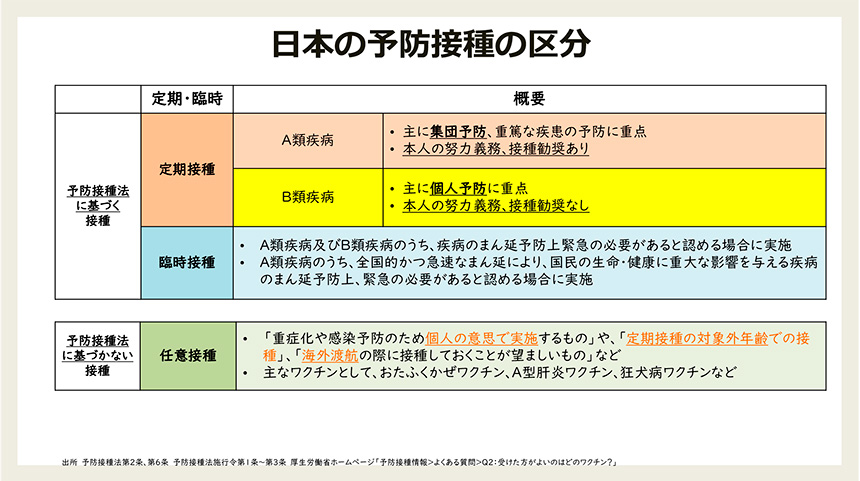
In Japan, vaccinations under the Immunization Law are classified into "routine vaccinations" and "occasional vaccinations" ( Figure 3 ). Routine vaccinations, which are administered on a daily basis as a countermeasure against infectious diseases, are determined based on the determination of at what age it is best to receive the vaccination. The temporary vaccination that attracted attention with the new corona vaccine was positioned as a special exception.
Vaccinations not based on the Immunization Law are called "voluntary vaccinations" and are given to those who wish to be vaccinated. However, basically, vaccinations based on the Immunization Law are also given with the understanding and consent of the individual and his/her guardian, and there is no system in our country to force vaccination.
Fig. 3 Classification of Immunization in Japan
(2) Vaccine-preventable diseases (VPD)
Diseases that can be prevented by vaccines are called Vaccine Preventable Diseases (VPD). Figure 4 shows the diseases for which the World Health Organization (WHO) recommends vaccination. Although not listed here, herpes zoster is an important VPD, and empox (monkeypox) is also a VPD. With so many VPDs, the vaccine gap has become an issue because there are not enough vaccines available compared to other countries, and this difference may have a negative impact on the health of the population.
Fig. 4 VPD (Vaccine Preventable Disease)
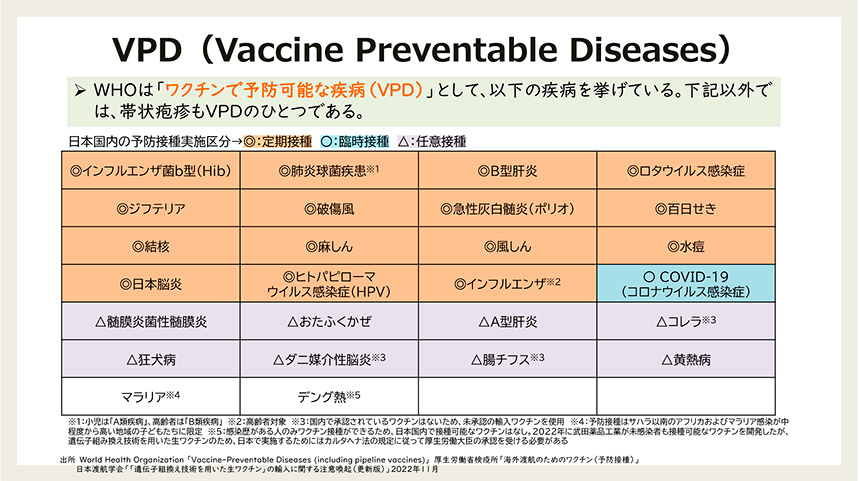
In Japan, the vaccine gap is being closed and many vaccines are now available, but the mumps vaccine has not yet become a routine vaccination. One of the reasons for this was the high incidence of aseptic meningitis after vaccination with the mumps vaccine, but the reasons for this increase have not necessarily been fully elucidated. One of the reasons for this is that there was an agreement at the study group that the mumps vaccine would be included in the routine vaccination program once a superior vaccine that minimized the incidence of aseptic meningitis was developed.
Another issue in our country is the current lack of growth in the pneumococcal vaccine coverage among the elderly. At the time of the introduction of this vaccine, there were concerns that two doses of pneumococcal vaccine for the elderly within five years would cause very strong adverse reactions, and so the arrangement was made to vaccinate every five years. Currently, there is some discussion as to whether this might be the reason for the lack of growth in vaccination rates.
(3) Interpretation of duty of effort
In 1994, there was an amendment to the Immunization Law that changed the policy in an extremely significant way. It was stipulated that vaccinations were to be given based solely on the will of the individual and his or her guardians, i.e., they were not to be forced. The concept of "duty of effort" emerged as the opposite of what had previously been "compulsory vaccination. Although I recognize that "duty of effort" has very little nuance of "obligation," recently the word "obligation" has sometimes been associated with an image of coercion, as was the case with the new corona vaccine.
Since the law was revised in 1994, it is hoped that the most understandable form of response will be adopted for those who are currently being vaccinated.
Issues related to vaccination in the future
(1) New corona vaccine
Initially, Japan did not have a clear outlook on when it would become immune to the new coronavirus, i.e., the vaccination rate and the percentage of affected persons needed to control the infection. Under such circumstances, Japan chose to take a cautious approach, although not aiming for zero corona, and vaccination and infection control measures were promoted. As a result, the number of infections per population has remained low compared to Europe, the U.S., and G7 countries.
Although concerns about the bivalent vaccine were considered, including the immune imprinting phenomenon (the immune memory for the first vaccine strain that was inoculated affects the antibody titer of the mutant vaccine received thereafter, which does not increase sufficiently), it was decided to use the bivalent vaccine in consideration of the merits of broad immunization. Currently, the bivalent vaccine is also available for 5-11 year olds, and it has been decided to continue the special temporary vaccination program in FY2023, and preparations are underway for a phased-in vaccination program starting in May.
(2) Human papillomavirus (HPV) vaccine
Active vaccination recommendations for the HPV vaccine have finally resumed in April 2022. Furthermore, the 9-valent vaccine will be available as an inoculation based on the Immunization Law from April 2023 and can be used for catch-up vaccination for those who could not be vaccinated before. Although the frequency of pain is high as an adverse reaction, the benefits of the vaccine are so great that it is gradually gaining understanding. The Nagoya Study clearly showed that the adverse reactions that were a problem at the time were also seen in unvaccinated people, and this led to the resumption of the program.
(3) Decline in vaccination coverage
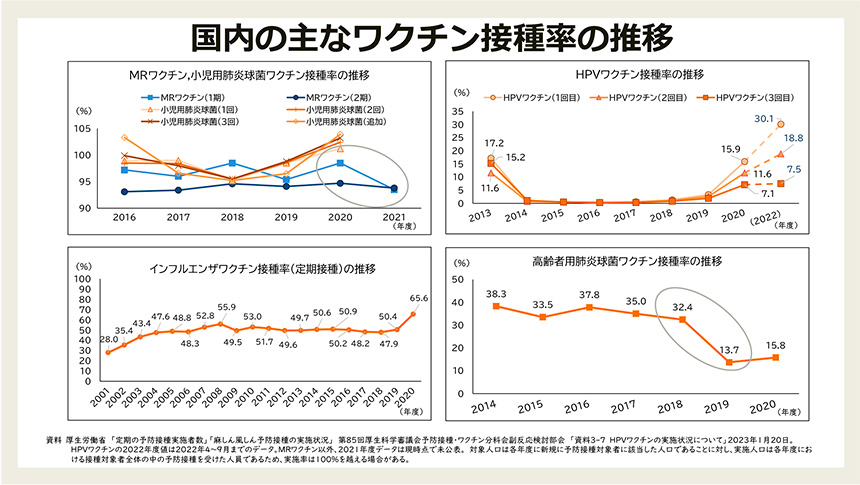
While vaccination coverage for children has remained high, it has been declining in the case of the coronary disease. In particular, there is concern that the decline in MR vaccine coverage could lead to a resurgence of measles and rubella outbreaks. Pregnant women who contract rubella are at risk of congenital rubella syndrome. The vaccination rate of the MR vaccine has traditionally been high for the first trimester, but tends to be slightly lower for the second trimester before school age, and the HPV vaccine is still low, although the vaccination rate is gradually increasing. The influenza vaccine has increased in vaccination coverage due to increased interest in the Corona disaster, but we will continue to monitor the trend in the future. The pneumococcal vaccine for the elderly has not recovered from the decline in immunization coverage and poses a major challenge ( Fig. 5 ).
Both vaccines must ensure immunization coverage in Japan. However, there are difficulties in deepening the public's interest in and understanding of vaccination. For example, it is not easy to restore the public's image of vaccination when they see some shocking cases of convulsions after HPV vaccination on video.
In addition, from now on, it will be more important than ever to grasp the status of vaccination implementation in a timely manner. We expect that the digitalization of vaccinations will improve this situation.
Figure 5 Major Vaccination Coverage in Japan
Significance and Value of Immunization
Immunization is a very important pillar in the fight against infectious diseases. Efforts to make excellent vaccines available in Japan and around the world are needed, and government support needs to be reconsidered. It is important that immunization protects not only individuals but also society from infectious diseases. It may be unbalanced to overemphasize the need to protect others, but I believe that this is something that should be communicated clearly. We believe that it is necessary to gain a broad public understanding of the need for vaccinations to protect health and lives at all stages of life.
( Itoyori Masuda, Policy Group Leader, Vaccine Practice Committee, Biopharmaceutical Committee)