


Topics Joint Symposium with the Joint Annual Meeting of the Japanese Society of Infectious Diseases and the Japanese Society of Chemotherapy Bringing antimicrobials from Japan back to the world! Building a Drug Discovery Ecosystem through Industry-Academia-Government Collaboration
Amid various developments related to countermeasures against AMR infections, such as the issuance of the Action Plan for AMR Countermeasures 2023-2027 in April 2023 and the G7 Hiroshima Summit and Nagasaki Health Ministers' Meeting in May 2023, the 97th Assembly and 71st Annual Meeting of the Japanese Society of Infectious Diseases (JSID) was held from April 28 to 30, 2012 at the Tokyo International Conference Center. The Pharmaceutical Cooperative Association of Japan (PPCJ), in collaboration with the Joint Conference, held the 97th Annual Meeting of the Japanese Society of Infectious Diseases and the 71st Annual Meeting of the Japanese Society of Chemotherapy from April 28 to 30. The JPMA, in collaboration with the Joint Conference, held the "97th Annual Meeting of the Japanese Society of Infectious Diseases and the 71st Annual Meeting of the Japanese Society of Chemotherapy" from April 28 to 30, 2010! The symposium introduced initiatives to promote drug discovery from the standpoints of industry, academia, and government, and a panel discussion was held on the promotion of drug discovery research for new antimicrobial agents and the industry-academia-government collaboration necessary to achieve this goal.
 Panel discussion
Opening of the Symposium
Dr. Kazuhiro Tateda, Professor, Department of Microbiology and Infectious Diseases, Toho University School of Medicine
The time has come to seriously address, discuss, and act on the issue of drug resistance (AMR). We must reaffirm the importance of AMR-related efforts, and industry, academia, government, and the public must come together to address this issue. In the "Action Plan for AMR Control 2023-2027," the establishment of a mechanism to continue the promotion of antimicrobial drug discovery was adopted, and the introduction of pull-type incentives came to be discussed as a keyword. However, it is also important to recognize that it is difficult to sustain antimicrobial drug development only by introducing pull-type incentives. He introduced the idea of building a drug discovery ecosystem as a way to address these issues, and explained that he would like to discuss this as the theme of this symposium.
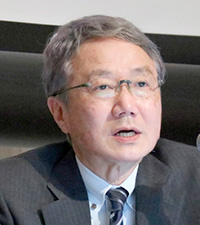
Keynote Speech
Overview of the Drug Resistance Problem and the Need for Novel Antimicrobial Agents
Dr. Takao Omagari, Director, International Center for Infectious Diseases, National Center for Global Health and Medicine
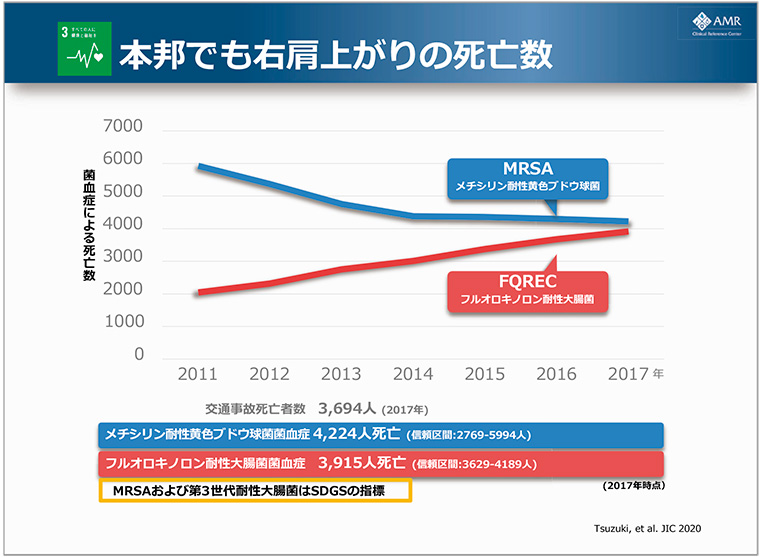
The keynote address was given from the perspective of global issues surrounding AMR and government-led efforts to address these issues. 2019 global deaths were caused by AMR, followed by malignant neoplasms, ischemic heart disease, and stroke, with human immunodeficiency virus (HIV)/acquired immunodeficiency syndrome (AIDS), malaria, and other infectious diseases. AMR causes more deaths than human immunodeficiency virus (HIV)/acquired immunodeficiency syndrome (AIDS) and malaria. In Japan, methicillin-resistant Staphylococcus aureus (MRSA) and fluoroquinolone-resistant Escherichia coli (FQREC) infections alone account for more than 8,000 deaths annually ( Figures 1 and 2 ).
Figure 1: Global deaths by disease
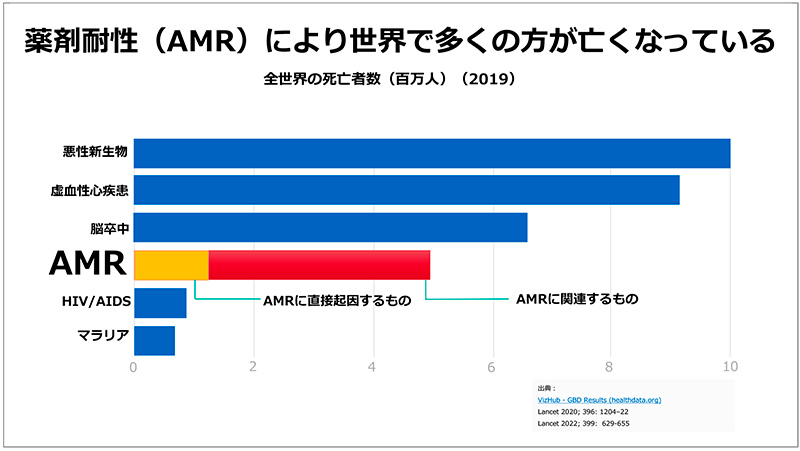
Fig. 2 Number of deaths due to bacteremia in Japan
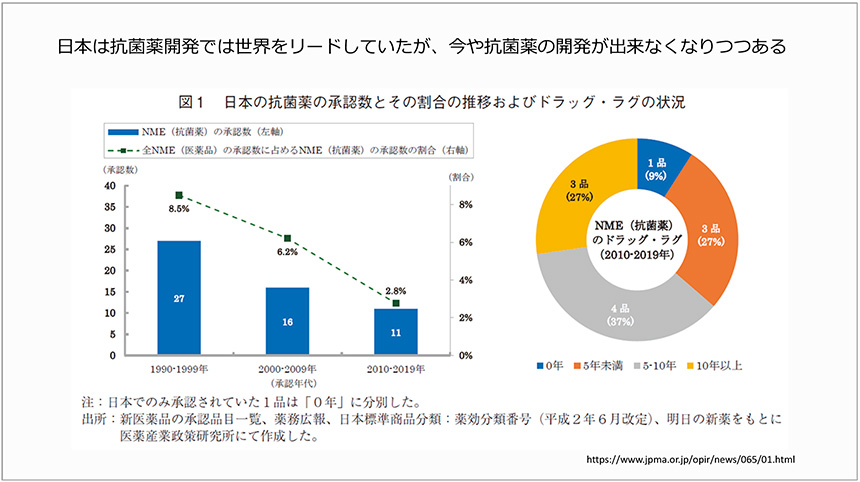
In Japan, the number of new antimicrobial agents approved to fight AMR is on a declining trend, and a so-called drug lag, in which antimicrobial agents approved and used worldwide are not approved in Japan, has emerged, raising concerns about the future treatment of AMR infections ( Fig. 3 ).
Fig. 3 Number of antimicrobial agents approved and drug lag in Japan
He also included clinical cases of actual AMR infection patients and introduced the "fear of treating infectious diseases in the absence of therapeutic drugs" as experienced with new coronavirus infection (COVID-19), and pointed out that it is important to immediately take measures against AMR, which is said to be a silent pandemic. He also introduced an outline of the "Action Plan for AMR Control 2023-2027," which calls for the "sustainable development of antimicrobial agents and enhancement of stable supply," and stressed the importance of steadily implementing the Action Plan in order to achieve sustainable development of antimicrobial agents and enhancement of stable supply.
Lecture 1
Research on drug-resistant bacteria (therapeutic drugs)
Yohei Doi, Professor, Department of Microbiology and Infectious Diseases, Fujita Medical School
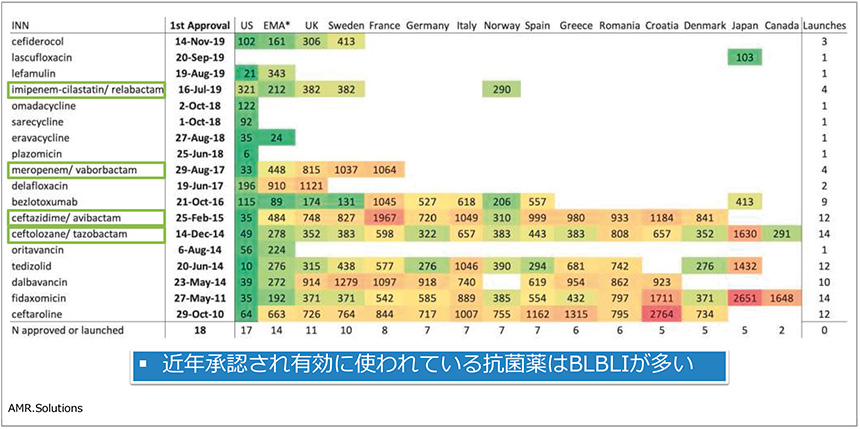
He described efforts in U.S. laboratories regarding drugs for the treatment of drug-resistant bacteria. In the past 50 years, no new class of antimicrobial agents against Gram-negative bacteria has been developed and commercialized, and most recently approved antimicrobial agents tend to be combinations of β-lactams and β-lactamase inhibitors (BLBLIs) ( Fig. 4). With the idea that we could try to break the resistance mechanism by a mechanism other than BLBLI, we focused on fosfomycin, which is still widely used, and started a search for its inactivating enzyme inhibitor. In collaboration with other laboratories and researchers, we analyzed the gene sequences of various bacteria species, resulting in the identification of the target gene sequence and structural analysis of the active site of the inhibitor.
Fig. 4 Antimicrobial agents approved and commercialized in recent years
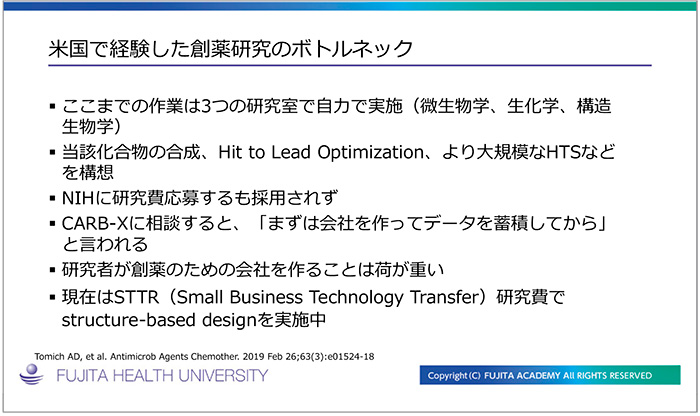
As the next step, he wanted to optimize lead compounds and conduct a large-scale high-throughput screening (HTS), and applied to the National Institutes of Health (NIH) and CARB-X*1 for research funding, but this did not materialize and there were bottlenecks in advancing drug discovery research. He introduced his actual experience. In particular, he mentioned that he sometimes faced situations where he was required to create a company to accumulate data, and in reality, it was very burdensome for a researcher to create a company ( Figure 5 ).
-
1International public-private partnership to promote research and development of innovative approaches to drug-resistant bacterial infections
Fig. 5 Bottlenecks in drug discovery research experienced in the U.S.
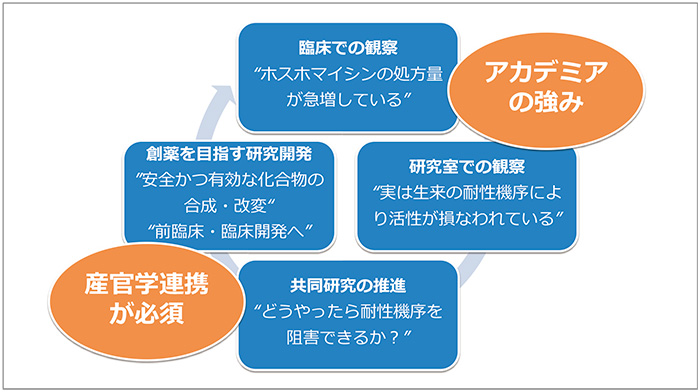
Taking advantage of the strength of academia, which can generate seeds and ideas through findings in clinical settings and in laboratories, is considered an effective means in drug discovery. In order to move from the exploratory stage to the next stage of drug discovery, it is necessary to strongly promote the flow of candidate compounds that have potential as drugs while utilizing the support framework of industry-academia-government collaboration, and he expressed his hope that such efforts will become mainstream in Japan ( Figure 6 ). In the supplementary budget for FY2021, the government has included the following items in the budget
Fig. 6 Industry-academia-government collaboration system that leverages the strengths of academia
Lecture 2
Drug Discovery Venture Ecosystem Enhancement Project
Dr. Tetsuya Ito, Director, Research Results Development Division, Department of Practical Use Promotion, Japan Agency for Medical Research and Development
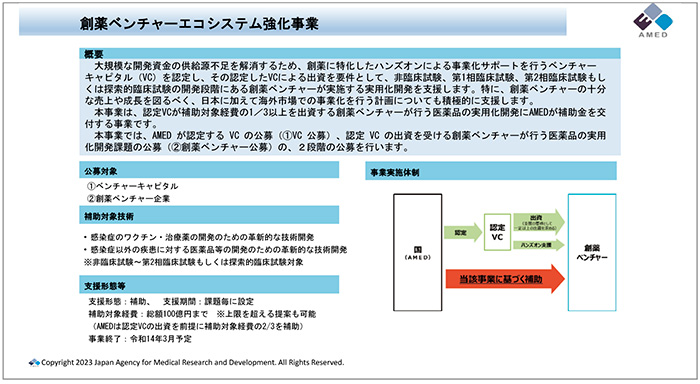
After introducing the history and activities of the Japan Agency for Medical Research and Development (AMED), he explained about the Drug Discovery Venture Ecosystem Enhancement Project offered by the AMED. The role of venture companies in new drug development is well known, but because R&D in the drug discovery field takes a long time, requires a large amount of R&D expenses, and involves considerable risk, the hurdles to commercialization as a venture are higher than in other fields.
In particular, the Japanese ecosystem does not allow for smooth financing and supply. To address this problem, AMED has launched this program, in which AMED provides a subsidy equivalent to 2/3 of the development of a drug for commercialization to drug discovery ventures in which AMED-approved venture capital (VC) invests at least 1/3 of the subsidy eligible expenses ( Fig. 7 and Fig. 8 ).
Fig. 7 Drug Discovery Venture Ecosystem
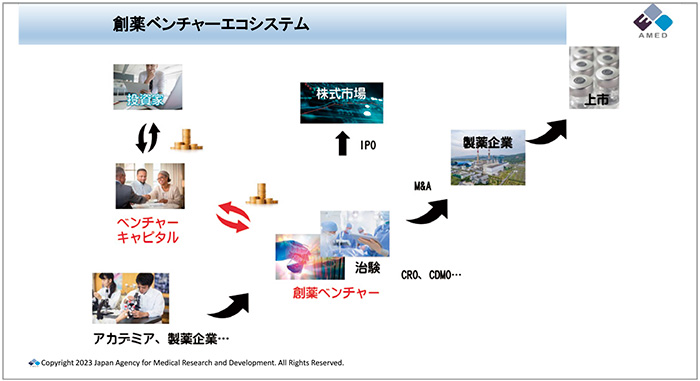
Fig. 8 Outline of the project to strengthen the drug discovery venture ecosystem
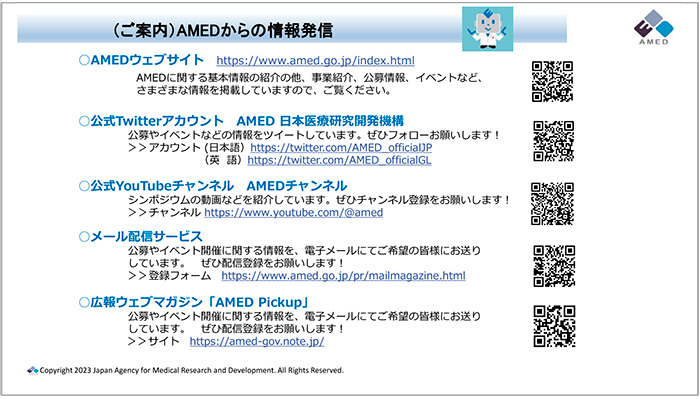
In the fiscal 2021 supplementary budget, a 50 billion yen budget was allocated for the Vaccine Strategy Project, and in the fiscal 2022 supplementary budget, a 300 billion yen fund was prepared for drug discovery in general by expanding the target fields. By supporting venture companies, which do not have many resources, to create new drugs from seeds discovered in academia, etc., it is expected to foster venture companies in Japan and strengthen drug discovery capabilities. In developing such support projects, AMED has prepared various consultation services, and we have been requested to make use of them. Furthermore, it was introduced that information is disseminated through various media, and the access information was shared ( Fig. 9 ).
Fig. 9 Information dissemination from AMED (access information)
Lecture 3
Efforts of the Pharmaceutical Industry to Establish a Drug Discovery Ecosystem
Dr. Yasunori Tawaraki, Leader, AMR Advocacy Task Force, International Affairs Committee, JPMA
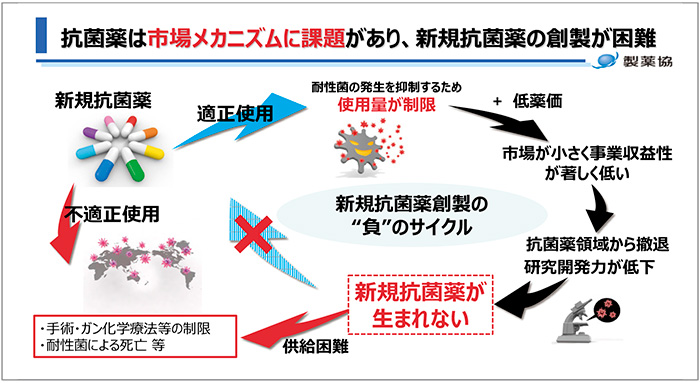
The JPMA introduced that AMR is one of the important global health issues, and that it is working on measures to address it in cooperation with pharmaceutical organizations in various countries. He then pointed out that one of the problems faced by companies is that there are serious challenges in the market mechanism for antimicrobial agents, making it difficult to discover new antimicrobial agents ( Fig. 10 ).
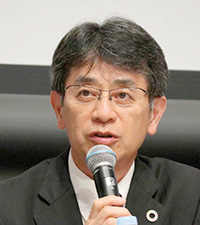
Fig. 10 "Negative" cycle of new antimicrobial drug discovery
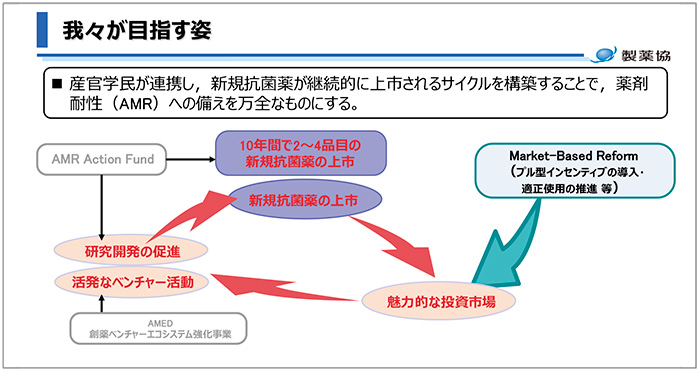
As a countermeasure to this issue, it was explained that there are two types of incentives: push-type incentives, which mainly support R&D, and pull-type incentives, which increase profitability after the product is launched. As a push-type incentive, he introduced the AMR Action Fund to be launched in 2020 by more than two dozen global pharmaceutical companies with an investment of approximately US$1 billion, aiming to launch two to four new antimicrobial agents in the next 10 years through support for venture companies. The introduction of pull-type incentives is being considered or has already been introduced by the governments of various countries, and the realization of market-based reform that balances the development of sustainable antimicrobials with the limitation of antimicrobial use through appropriate use is expected to create an attractive investment market and stimulate venture activities. He stated that the ideal situation would be to create an attractive investment market and to stimulate venture activities ( Fig. 11 ).
Fig. 11 The drug discovery ecosystem
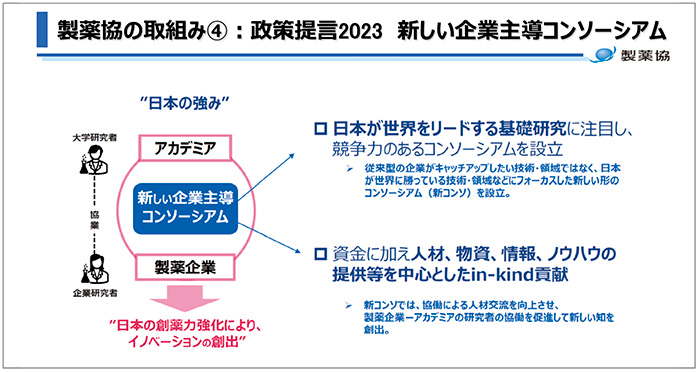
He also introduced JPMA's proposal for the formation of a new company-led consortium with academia as a partner in the early stages of research ( Fig. 12 ).
Finally, he mentioned that the Cabinet Office, Ministry of Health, Labor and Welfare, and Ministry of Economy, Trade and Industry are implementing various measures to promote drug discovery, and expressed his hope that the industry will commit to cooperate with these projects and develop them into a system that supports sustainable entrepreneurship and growth through close collaboration between industry, academia, and government.
Fig. 12 New company-led consortia
Panel Discussion
Panelists
Dr. Tsuyoshi Yamamoto, Director, Office of Venture Support Strategy, Pharmaceutical Industry Promotion and Medical Information Planning Division, Medical Policy Bureau, Ministry of Health, Labor and Welfare
In the panel discussion, the theme was "For seamless efforts by industry, government, and academia toward the practical application of new antimicrobial agents" and the panelists discussed the issue from their respective perspectives.
Initiatives at MHLW
Dr. Yamamoto introduced various efforts to support ventures in the Ministry of Health, Labour and Welfare (MHLW). He also indicated that incentives for the development of antimicrobial agents for AMR should not be considered only in Japan, but should be promoted in cooperation with other countries from a global perspective.
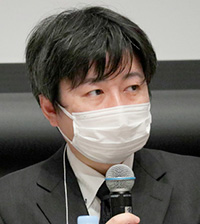
Challenges and Initiatives in Academia Involved in Drug Discovery Promotion
Mr. Doi indicated that although he is aware that various frameworks are available to support drug discovery promotion, he is not sure how to take the first step and often has difficulty in reaching such frameworks. They also requested that support be provided to answer basic questions (e.g., to what level of data should be prepared).
It was shared once again that although a framework for supporting venture companies has been prepared, there is a lack of support for researchers to launch their own venture companies, and it was recognized that a system to support researchers is needed. He also expressed the hope that the JPMA's proposal to establish a consortium in which academia can participate will make it easier for academia to get involved in drug discovery if industry can share the regulations and intellectual property necessary for drug development.
Similarly, some from the floor sympathized with the difficulties faced by researchers in starting up a venture, and expressed hope that a consortium would be established.
Expectations for the Drug Discovery Venture Ecosystem
In the case of antibacterial drugs, the possibility of drug discovery is low, and there were questions raised about the difficulties involved in starting a drug discovery venture, such as whether VC firms would actually come forward to provide financial support, and to what extent failure would be tolerated.
Mr. Ito explained that overseas VC-led corporate venture capital (CVC) initiatives have begun, and that there are ways to consult with such VCs. He also reiterated that AMED's projects support themes for which a large market cannot be expected or for which research and development is difficult.
Mr. Tawaraki introduced the fact that VCs had clearly stated that they were reluctant to invest in projects with no clear exit strategy, and he expressed his opinion that institutionalizing pull-type incentives as a national system would clarify exit strategies and make it easier for VCs to invest. Furthermore, regarding the drug discovery ecosystem, it was suggested that it would be beneficial to share and disseminate information, such as the Ministry of Health, Labor and Welfare's consultation program and the AMED's various consultation services, by bringing together industry, academia and government officials to introduce successful cases. He also expressed the hope that JPMA could set up such opportunities, and that through such activities, it would be possible to make academia more familiar with the government's systems in an easy-to-use manner.
Dr. Yamamoto also mentioned that the government is struggling with how to recover the cost of R&D by pharmaceutical companies and research in academia, and reiterated that one direction to take is to think in terms of cooperation with the rest of the world, for example, by expanding investment and recovery not only in Japan but also globally. The presentation reaffirmed the recognition that the industry should consider cooperating with the rest of the world, not only in Japan, but also globally.
In terms of responding to academia, he introduced the Medical Venture Total Support Organization (MEDISO), which supports venture companies and academia and provides free advice on strategies for pharmaceutical affairs, intellectual property, etc., which he hopes will be utilized.
From the floor, Dr. Tetsuya Matsumoto, Professor at International University of Health and Welfare and President of the Japan Society of Chemotherapy, commented that through the discussions at this symposium, solutions through industry-academia-government collaboration had become apparent, and that he hoped Japan would take further measures to encourage R&D in the domestic pharmaceutical industry on a national scale. He also expressed his hope that Japan would take further national measures to boost R&D in the domestic pharmaceutical industry.
Summary
Dr. Kazuhiro Tateda, Professor, Department of Microbiology and Infectious Diseases, Toho University School of Medicine
The G7 Hiroshima Summit 2023 will be held in May, and we expect that the G7 Summit will address COVID-19 as a pandemic and the AMR problem as a silent pandemic. We must keep a close eye on how Japan will show leadership at the G7 in 2023 and how the direction of countermeasures against infectious diseases will be presented.
At the G7 Ise-Shima Summit in 2016, the first Action Plan for AMR control was issued, and the second Action Plan was issued in April 2023. In the plan, the introduction of pull-type incentives is also mentioned. This is a very important issue, and given the fact that the introduction of pull-type incentives is also underway in the U.K., Sweden, and the U.S., it is important that we, as an academic society, discuss the ideal incentive system in Japan and consider a new mechanism to promote drug discovery through collaboration among industry, academia, and government. We would like to continue to discuss this issue together with you.
Concluding Remarks
The development of antimicrobial agents for AMR is an issue that should be addressed through collaboration between industry, academia, and government. JPMA will continue to actively incorporate new knowledge into its activities to help solve the problem of AMR.
( Shigeru Usui and Akio Ozaki, AMR Advocacy TF, Infectious Diseases Group, Global Health Subcommittee, International Affairs Committee)