


Topics JPMA Media Forum" Held -The current trend of science, technology and innovation from a bird's eye view of the life science field and its implications for the drug discovery field
On February 27, 2023, the JPMA Public Affairs Committee held a media forum at Muromachi Mitsui Hall & Conference (Chuo-ku, Tokyo) on the theme of "A Bird's-Eye View of the Life Science Field: Implications for the Drug Discovery Field" by Dr. Hiromoto Shimazu of the Life Science and Clinical Medicine Unit, Center for Research & Development Strategy (CRDS), National Institute of Science and Technology (JST). The media forum was titled "Trends in Science, Technology and Innovation and Implications for the Drug Discovery Field" by Dr. Hiroki Shimazu of the Center for Research and Development Strategy (CRDS), JST. The event was attended by 20 members of the press from 17 companies through both on-site and online participation.
CRDS, to which lecturer Hiromoto Shimazu belongs, is a think tank specializing in science, technology, and innovation, and collects information on R&D trends at home and abroad, as well as on policies related to science, technology, and innovation overseas. CRDS also publishes a "bird's-eye view report" every two years, providing a bird's eye view of R&D trends.
In this presentation, he introduced some of the major trends that emerged from his bird's-eye view of the life science field, including diversification of modalities, digital transformation of drug discovery (DX), AI drug discovery, and other notable scientific technologies. Explanation was also given on a wide range of topics, including global trends in innovation systems in the drug discovery field and implications for the Japanese drug discovery field, given the recent concern over the decline of Japan's R&D capabilities.
The following is a summary of Dr. Shimazu's presentation.
Trends in science, technology and innovation from a bird's-eye view of the life science field and their implications for the drug discovery field
Dr. Hiromoto Shimazu, Life Science and Clinical Medicine Unit, Center for Research and Development Strategy, Japan Science and Technology Agency
1. major trends emerging from the bird's eye view of the life science field
In the 2021 edition of the bird's-eye view report, we selected 36 areas divided into four categories from several perspectives, such as socioeconomic impact, scientific and technological emergence, and key areas that must be monitored on a regular basis. We compared the research capabilities in each of these 36 areas with those of other major countries and with R&D trends in Japan and overseas. Looking over these 36 areas and listing these as micro trends, "15 noteworthy technologies, science and technology" were extracted ( Figure 1 ).
Figure 1: 15 Noteworthy Trends from a bird's-eye view
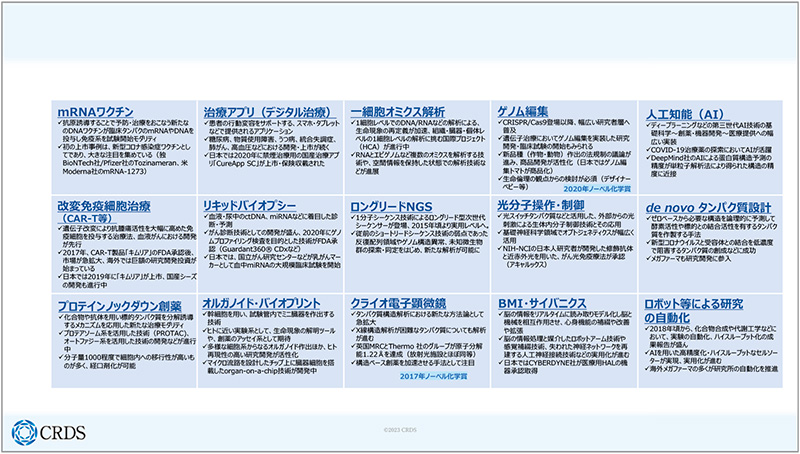
Many of the 15 trends listed here have been or are being innovated by start-ups, and many of them originated from universities and national research institutes. In Japan, it is difficult for such innovative technologies and innovations to be developed, and recently, the whole country has been focusing on start-ups.
2) Notable trends in science and technology related to drug discovery
(1) Diversification of modalities
The first is "diversification of pharmaceutical modalities" ( Figure 2 ). This was a period of major change in the industry. More recently, with the emergence of drugs such as CAR-T therapy, the basic modalities of drugs, such as small molecules, proteins, antibodies, and cells, are now generally in place. On the other hand, how to handle such a wide range of modalities for each pharmaceutical company and for research in Japan as a whole will become an issue in the future.
Figure 2 Diversification of pharmaceutical modalities
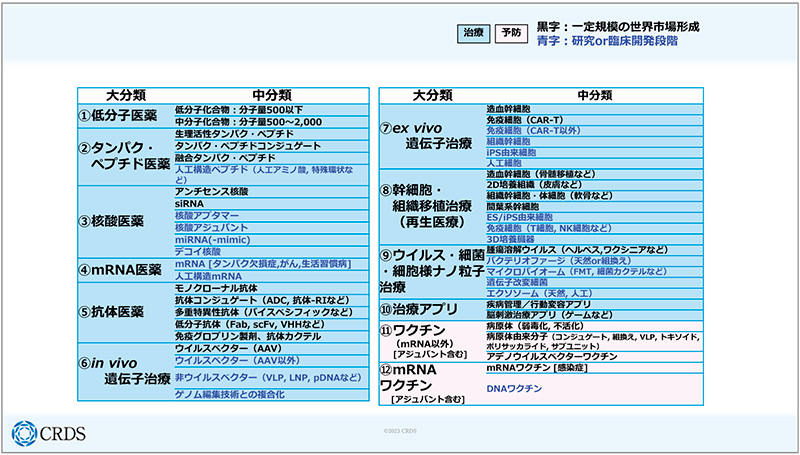
Recent examples of groundbreaking drug discovery innovations include "immune checkpoint inhibitor therapy," "CAR-T cell therapy," and "mRNA vaccines. All of these were thought to be unfeasible by most researchers 10 to 15 years before social implementation. Since it is in the field of drug discovery that what many experts said would be difficult is actually realized, I think this is an area that is truly a symbol of entrepreneurship.
To further explain some of the points of interest, small molecule drug discovery used to be the mainstream, but small molecules have traditionally targeted proteins that have a pocket to which a specific ligand molecule can bind. In other words, a small molecule would snap into the target protein and inhibit its interaction with others. However, there is a limit to the number of proteins that can be targeted by this alone, and it is said that the current field of small molecule drugs is "running out of targets.
Therefore, methods of using small molecules in a different way have been studied, and as an example, "targeted protein degradation" is introduced here. In this method, a low-molecular compound that can bind to both the target protein causing the disease and the protein involved in the degradation mechanism of the protein is orally administered to bring the two proteins into close proximity, thereby reducing the amount of the disease-causing protein. By targeting proteins that could not be targeted by conventional small molecule drug discovery, attempts are being made to further expand the potential of small molecule drugs.
Next, "extracellular microparticles (exosomes)" are a new modality in the research and development stage. These are membrane vesicles released from cells. These particles contain DNA, mRNA, proteins, and various other substances, and it has become clear over the past 10 to 15 years that they are running around in the body. Currently, research is being conducted on the possibility of using exosomes, which are circulating throughout the body, for drug delivery and drug discovery by expressing existing drugs on the surface of exosomes.
The third is "optogenetics. This is a type of gene therapy that uses light to control proteins, and is considered one of the top three candidates for the Nobel Prize. Optogenetics is actually being used in therapy, and as a basic research stage, there is a lot of research being done on its potential use in various neurodegenerative diseases.
The last of the modality trends is Digital Therapeutics (DTx). In the past, "health promotion apps" like step counters were the mainstream, but since the first diabetes treatment aid app was approved by the U.S. Food and Drug Administration (FDA) in 2010, many DTx apps have emerged that allow users to manage and treat their own conditions using their smartphones. Three have already been approved from Japan, including an application for treating nicotine dependence, hypertension, and insomnia. Japanese pharmaceutical companies are also challenging this modality by teaming up with venture companies that are DTx vendors.
(2) Drug Discovery DX, AI Drug Discovery
As for Drug Discovery DX and AI drug discovery, from 2019 to 2020, papers have started to appear showing that compounds discovered through AI drug discovery have advanced to preclinical stage. This was around the time when Japanese companies also started collaborating with overseas startups, and I believe that 2020 was the first year of AI drug discovery.
One noteworthy trend was the news that AlphaFold, a subsidiary of Google, was able to predict the 3D structure of proteins with extremely high accuracy. This was also named Science magazine's Breakthrough of the Year for 2021. The amazing thing about this technology is that it has actually predicted and published over 200 million proteins in just a few years. What is even more interesting is that the amino acid sequences of artificial proteins can be freely designed by computer. David Baker's laboratory at the University of Washington is very well known for its research on the successful use of such "artificial proteins" not found in nature for drug discovery, and many venture companies have actually been born from there.
As for the progress of AI drug discovery, it was reported in a paper in 2022 that about 20 products have entered clinical trials through AI development as drug candidates. Furthermore, while research used to be dominated by AI discoveries of small molecules, it is now being used for complex substances such as antibodies, and several companies are using AI to discover new monoclonal antibodies and biopharmaceuticals.
As AI is increasingly used in drug discovery, the quality and size of the data will become very important. In this connection, I would like to explain the automation and autonomy of discovery. one trend that is emerging is the automation of discovery, especially autonomy, as an example of research or startups. In this research, the key phrase is "closed loop*1." By creating a proper closed loop, information is fed back and new things are discovered. The key is naturally AI, but by using generative AI*2 generation models as a method of data generation, it may be possible to create many more complex substances in the future.
-
1A control method in which output results are fed back (re-input) to the input in a cyclical manner
-
2Also called generative AI, AI that can learn from data and creatively generate new productions and contents from scratch.
In addition, several AI drug discovery companies are attempting to build in-house robotized lab facilities to improve their ability to generate in-house data for AI training. The idea is that if you don't have the data, you can use high-throughput experiments that utilize robotics to actually create the data.
Next, I would like to introduce a high-throughput technology that utilizes imaging. There is a Nobel Prize-winning technology called super-resolution microscopy, and it is now possible to see at the microscope level what the macroscopic structure of proteins in cells looks like. By combining this with AI, for example, by arranging tens of thousands of cells on a plate, deciding which proteins to look at, and conducting experiments in which different drugs are sprinkled on each line, it is possible to track a large amount of information at once, at the protein level, in tens of thousands of cells. This is the era in which it is possible to track a lot of information at once at the protein level in tens of thousands of cells.
Another application of advanced science and technology is single-cell omics analysis. In the past, when analyzing cancer tissue, we analyzed it as a "mass of cancer cells. Nowadays, however, single-cell omics technology has developed very well, and it is possible to take out cancer cells, separate them one by one, and look at their characteristics, making profiling of the microenvironment of cancer cells possible.
Drug discovery is now truly an integration of advanced technologies such as bioinformatics, imaging, cellular and molecular biology, and human genetics. I think the current situation is that this is now being done with even higher throughput, higher precision, and an explosion in the amount of information.
Until now, we have been talking about the discovery stage, but we are now in an era in which technologies such as organ chips and organoids*3 are being used for research in the latter stages of drug discovery. This is due to two factors: first, there is the problem of emerging social issues such as transportation restrictions and export bans on laboratory monkeys and their illegal capture in Southeast Asia; second, the FDA has approved the replacement of some clinical trials with these technologies.
-
3Also called mini-organs. Three-dimensional tissue created in vitro, such as in a test tube, from stem cells
Because of these two factors, I believe that we will continue to see better connectivity between preclinical research in discovery and clinical results in humans by replacing some of the clinical trials with organ chips and organoids. This field may still have a bit of a long way to go, but several start-up companies have already emerged.
Finally, I would like to introduce the use of AI in clinical trials and other distributed clinical research. There is research on how AI can be used to recruit patients, remotely watch patients participating in clinical trials, and replace the composite target group of randomized controlled trials with a simulation, and AI is being used in a variety of ways in clinical trials as well.
There have been major trends in drug discovery in the past, such as "biopharmaceuticals" in the 1980s and "genomics" in the 1990s, and "AI/DX" from the 2010s is expected to continue as a major trend in the mid- to long-term. Drug discovery is the most knowledge-intensive and interdisciplinary science, technology, and industry, and it must make full use of omics technology, genome editing technology, cryo-electron microscopy, super-resolution microscopy, AI, simulation calculations, and other such technologies. I feel that this will be an increasingly difficult era in the future.
In addition, many technologies originate from Europe and the U.S., and Japan tends to neglect technological research, and collaboration among different fields has not progressed well. Furthermore, the extremely high cost of research for the advanced technologies introduced today is also an issue, and we must consider how to participate in such research in the future.
(3) Healthcare Transformation
I have been talking about DX for treatment and drug discovery, but DX is naturally being used for prevention and diagnosis as well. The major trend is from treatment to prevention, and from "uniformity" to "individualized" and "stratified" prevention, diagnosis, and treatment.
Worldwide, healthcare funding (investment in the healthcare field) is actually about 8 trillion yen, and about three-eighths of that is "investment in the digital health field. There are a great number of health tech and digital health startups around the world that have become unicorns.
Japan lags behind in this field. To begin with, DX requires the technological development of AI, cloud computing, and real-world data from devices and other sources. The field of drug discovery, which I have mentioned so far, is a business-to-business field, but many digital health and health tech startups are emerging around the world in the B to C field, which provides some kind of service to individuals. These fields are attracting a lot of attention because there is a lot of money involved.
In terms of medical applications, in the past, it was only necessary to look at data from medical devices in medical institutions, but now data can be obtained from wearable devices and smartwatches used in daily life. Now, however, data can be obtained from wearable devices and smartwatches used in daily life. Furthermore, data can be obtained from smartphones and monitoring systems installed in the home throughout the day, and physiological, behavioral, and environmental data can be gathered.
The first is "liquid biopsy," which is used for preventive diagnosis. Research has shown that blood and urine contain signals for various diseases. It is believed that various diseases can be detected at an early stage from the blood and urine. In the case of a clinical trial currently underway, 50 types of cancer can be detected with a single blood sample, including the type of cancer, and the false positive rate is less than 1%.
When such services are introduced to society, I believe that society will change a little from what it is today. Since companion diagnostics*4 are also being utilized in this field, pharmaceutical megapharmaceutical companies are also investing considerably in this field. Currently, the focus is overwhelmingly on oncology, but I believe that in the next 10 years or so, the use of companion diagnostics for neurodegenerative diseases and other conditions will also progress and be implemented in society.
-
4Diagnostics developed in combination with pharmaceuticals for specific therapeutic agents
Next, we have digital biomarkers. The most obvious example is the smartwatch, but there are other ways to monitor signals in the human body that can be remotely monitored by a variety of devices. For example, continuous glucose monitoring (CGM) for diabetics has become mainstream, and there has been news that Apple's smartwatch will allow monitoring without actually sticking a needle into the skin.
In addition, brain-machine interface is being studied as a digital biomarker. There are examples of applications such as actual use in diagnosis, or the ability for patients with spinal cord injuries to move their limbs or operate computers simply by thinking about something. There are also reports of implanted devices being used for treatment.
Another application of DX is clinical decision support for physicians. The first progress in this area was made in China. The Ping An Insurance Group in China is using online medical interviews and telemedicine to improve the efficiency of medical care. This is due in part to the efficient use of electronic medical records as data.
Babylon Health in the U.K. also offers a service in which you enter your symptoms into a chatbot-type application like LINE, and an AI automatically responds to your input. This is not a formal diagnosis, but it is possible. Furthermore, this field is expected to expand tremendously in the future, with Microsoft's acquisition of Nuance for 2 trillion yen in terms of medical record entry efficiency.
Finally, in the report on what areas Google, Microsoft, and Apple are focusing on, remote clinical trials, digital biomarkers, and AI drug discovery were mentioned. I believe that in the mid- to long-term, a portion of drug treatments will be replaced by preventive services such as digital biomarkers.
In contrast to countries like the U.S., where real-world evidence is being collected mainly by private companies and insurance companies, I do not think this will be the case in Japan. Therefore, I think it is necessary to have a framework for sharing some kind of data in society, centering on the national government. This is why we have the Next Generation Medical Infrastructure Act, and I think it is a challenge for Japan to continue to expand and evolve this kind of framework.
Trends in the innovation system in the field of drug discovery
In the 2010s, many more new technologies have emerged, and the culture of startups has been growing. In the 2010s, the startup culture took root with the emergence of many more new technologies, and we are now in a situation where startups are very much on the rise. In the U.S., for example, the emergence of innovative science and technology and the launch of ventures and startups are proceeding simultaneously. On the other hand, this is not the case in Japan, and we can see that a gap has emerged between science and technology and the launch of ventures.
Fig. 3 History of bio-ventures and technology
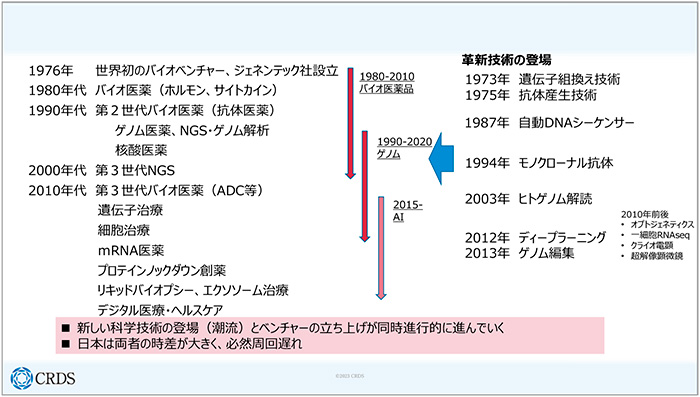
The first generation of biopharmaceutical ventures was born in 1976, one after the other. Over the next 30 years or so, biopharmaceuticals accounted for about half of all pharmaceuticals. Now that cell therapy, gene therapy, and nucleic acid drugs are gradually entering the market, it would not be surprising if these new modalities account for about 30% of all pharmaceuticals in the future.
What has been happening during these changes is that research and development costs have risen dramatically, from approximately 100 to 300 billion yen per drug. On the other hand, the average R&D cost of the top 10 pharmaceutical companies in Japan is less than 200 billion yen, so it is important to consider this issue.
At the same time as R&D expenditures, we must also look at the investment activities of corporate venture capital (CVC) *5. Since 2011, many so-called global pharmaceutical megapharma CVCs have been lined up in the ranking of companies with the highest number of investments. In other words, we can see that open innovation is progressing more and more, not only in terms of R&D expenditures, but also in the form of investment.
-
5A fund organized by an operating company (large company) for the purpose of investing in and supporting venture companies
Thus, innovation cannot be judged only by looking at R&D trends. About 80% of megapharma M&A targets are start-ups. If we simply take the average amount of domestic and foreign acquisition deals since 2014, it amounts to about 200 billion yen per deal. One problem is that we are now in a world where capital is very important in various ways, such as R&D expenses, investments, and acquisitions. Another problem is the fact that there have been almost no cases of Japanese venture companies being the target of acquisitions in Japan or abroad.
In January 2023, there was news that Moderna acquired Orisilo Genomics, a start-up company from Rikkyo University, for approximately 11 billion yen. This is a landmark event in the history of technology transfer/startups in the field of university startups and biotechnology in Japan. Until now, acquisitions have probably been in the order of 1 billion yen, but this is the first acquisition of a Japanese biotech startup in the order of three-digit billion yen, and I hope that this kind of news will continue to happen in the future.
Against this backdrop, looking at the number of startups that entered Phase 1 of the FDA, the number of startups in 2011 was about 30%, but by 2021 it will be about 60%. Of course, there will be cases where startups are acquired by large companies before entering Phase 1, so in real terms, more than 60% of all startups will have originated from startups.
This shows that in the drug discovery field, the innovation model is changing decisively. Furthermore, although Japan is one of the few countries that create new drugs, unfortunately, we can see that its presence is gradually declining due to the rise of bio-venture companies and the fact that capital is becoming more and more important.
Implications for the Japanese drug discovery field
The situation surrounding drug discovery has so far included the depletion of targets, the diversification of modalities, and the advancement of DX/AI. Considering these events simultaneously, the presence of DX/AI, which is both an external and internal environment, will become increasingly significant. Since even megapharma is not sufficient with its own resources, open innovation with domestic and foreign academia/start-ups is a prerequisite. In this context, to summarize what strengths Japanese academia has, it is in these areas that Japanese researchers are highly evaluated in their papers ( Fig. 4 ).
Fig. 4 Examples of strengths of Japanese academia
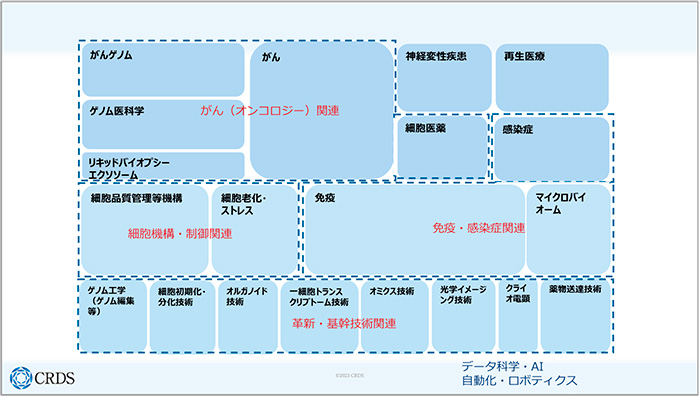
The strengths of Japanese academia can be broadly divided into four areas: the first is "oncology," the second is "cellular mechanisms and regulation," with notable recent research in autophagy and aging, and the third is "immunology and infectious diseases," where Japan has long been considered strong in the field of immunology. Recently, there has been some notable research in the microbiome. Finally, there is "Innovation and Key Technologies.
I think it would be good if these four or so strengths of Japanese academia could somehow be mobilized and used for drug discovery. On the other hand, many faculties of data science and AI have recently been established, and I believe that researchers will emerge in the future, but there is an issue of what to do in the interim until many such researchers emerge.
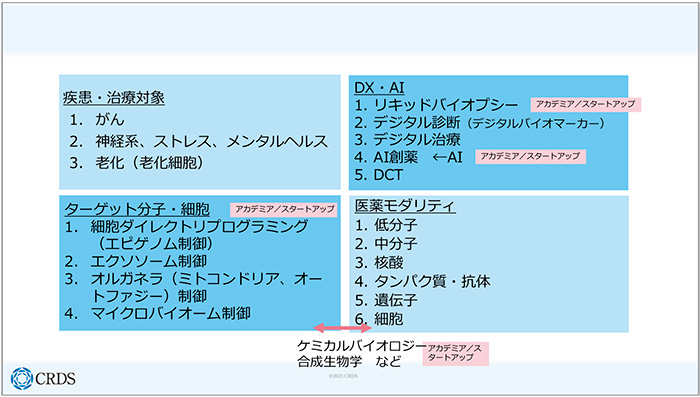
In closing today's discussion, I would like to consider some examples of noteworthy themes that could lead to innovative drug discovery and the contribution of academia, taking into account such strengths of Japan and the situation of the Japanese pharmaceutical industry. I believe that the search for target molecules and cells will grow in the future as academia/start-ups make various discoveries in the fields of life sciences and medical science. While pharmaceutical companies excel in individual drug modalities, I would like to see academia/start-ups do well in fields such as chemical biology and synthetic biology, which serve as a bridge between target molecules and drug modalities. We also believe that liquid biopsy and AI drug discovery are also areas where the knowledge of academia/start-ups can be used ( Figure 5 ).
Fig. 5 Examples of hot topics that could lead to innovative drug discovery and the contribution of academia
( Takafumi Adachi, Director of Public Relations)