


Topics|Topics Meeting of Compliance Managers and Practitioners for Fiscal Year 2022
On March 2, 2023, the JPMA Code Compliance Committee held the "FY2022 Meeting of Compliance Managers and Practitioners" in the same online format as in FY2021. The meeting was attended by 245 participants, including compliance managers and compliance practitioners from 71 member companies, and was conducted according to the program shown in Table 1. A summary of the meeting is reported below.
Table 1 Program of the "FY2022 Meeting for Compliance Managers and Practitioners"

Opening remarks
Prior to the meeting, Mr. Satoshi Tanaka, Chairperson of the JPMA Code Compliance Committee, stated the basic policy of the Committee for FY2022: "The Code Compliance Committee is committed to ensuring that member companies comply with relevant laws and regulations as well as with the JPMA Code of Practice and other voluntary codes, and that they conduct themselves with high ethical standards as members of life-related industries. The committee also outlines the four key tasks of the committee.
| <Fiscal 2022 Priority Tasks | |
| • | Support for member companies to promote compliance |
| • | Promotion of appropriate information disclosure based on the Transparency Guideline |
| • | Compliance with the "Guidelines for Activities Related to Provision of Marketing Information on Ethical Drugs |
| • | Collaboration, information collection, dissemination, and feedback with the government and related domestic and international organizations such as the Japan Pharmaceutical Manufacturers Association (JPMA), the Fair Trade Council of the Ethical Drug Manufacturers and Marketing Industry (JFTC), and the International Federation of Pharmaceutical Manufacturers and Associations (IFPMA) |
 JPMA Code Compliance
Satoshi Tanaka, Chairperson, Pharmaceutical Manufacturers Association of Japan (PMAJ) Code Compliance Promotion Committee
In closing, Mr. Akira Kunimatsu, Director of the Risk Monitoring Department of ELTES, thanked the audience for their attendance. He also expressed his hope that the audience would take away some insights from the lecture and take appropriate measures to deal with potential risks.
Revision of the JPMA Compliance Program Guidelines
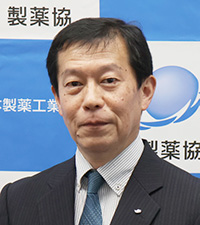
JPMA Code Compliance Committee Toshiyuki Yamano Chairperson
First, he explained that the JPMA Compliance Program Guidelines were established for the purpose of "ensuring compliance with laws and regulations," and explained the relationship between the JPMA Charter of Corporate Behavior and the JPMA Code of Practice.
He then explained the three main points in the revision of the guidelines.
| 1. | Revisions were made in Chapters 1 and 2 to reflect revisions of laws, regulations, and other codes since 2018 and the accompanying changes in the social environment. |
| 2. | In the "Referenced Laws and Regulations" section, new laws and regulations were added, and a new "List of Referenced Laws and Regulations and Their Abbreviations" was created and added, using abbreviated names. |
| 3. | In the section of "Referenced External Standards," additions and name changes were addressed, and the method of stating the name and source was changed to make it easier to understand. |
In closing, he said, "Each company should periodically check its own and its group companies' codes of conduct and compliance-related rules with reference to these guidelines, and revise them as necessary. In addition, please continue to implement initiatives to promote compliance by improving content in line with the nature and type of business," he concluded.
The latest discussion at the International Federation of Pharmaceutical Manufacturers & Associations (IFPMA) Ethics & Business Integrity Committee (eBIC)
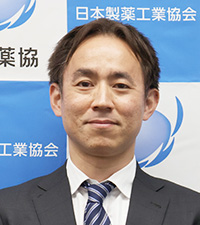
JPMA Code Compliance Committee Mr. Go Matsumura, Practice Committee Member
The five working groups (ESG, MLO Outreach, Innovation enabling, Responsible Engagement with Stakeholders, Code Explanation was given that the IFPMA has a Code of Practice, which is not legally binding, but member companies and member organizations are expected to comply with it. He then introduced the guidance published by IFPMA.
Finally, he concluded with a decision-making framework, which describes "what to do and in what order from the perspective of ethics and compliance when making business decisions," and which is available on the IFPMA website if you do not have such a framework. If you do not have such a framework, it is available on the IFPMA website and I encourage you to refer to it.
Special Lectures
Potential Compliance Risks Arising from the Use of Social Networking Services (SNS) and How to Respond to Them
Mr. Ryo Kunimatsu, General Manager, Risk Monitoring Department, ELTES
First, he talked about compliance and SNS, saying that the emergence of SNS has brought about changes in compliance. As a result, compliance violations have become more conspicuous.
Explanation was then given on "SNS users and their characteristics" and "SNS user population" as basic knowledge of SNS, and as the mechanism of SNS flame-outs, "flame-out" was defined as "a state in which criticism is flooded and spread online in response to offline and online actions and statements," and the process from outbreak to flame-out and major flame-out were explained. The process and the entities involved in the outbreak can occur at any company or individual.

He introduced the damage caused by social networking services, including "deterioration of business relationships," "loss of reputation," and "reputational damage" for companies, and "disciplinary dismissal," "invasion of privacy," and "slander" for individuals.
In the introduction of case studies, as "SNS risks specific to the pharmaceutical industry," he stated, "The use of official SNS for the purpose of disease awareness, etc. is increasing. Explanation: "There are an increasing number of cases in which official social networking services are used to raise awareness of diseases, etc. Comments from users may include adverse events, and there is a risk that they may be left unnoticed.
In closing, he said, "I would like people to recognize that SNS users, as well as those who do not use SNS at all, are by no means unaffected. If we pay more attention to social trends and changes related to SNS, it will be easier for us to judge the importance of risks.
Closing Remarks
JPMA Managing Director Yoshiyuki Ishida expressed his gratitude to the compliance managers and compliance practitioners for their participation in the meeting and thanked Mr. Kunimatsu, the special speaker, for his presentation.
The theme of our meeting can be summed up in one word: "Expanding and Changing Scope of Compliance. In the past, offensive matters, such as the expansion of business performance, have been emphasized within companies, but nowadays, the content of compliance has become more profound, and I think it is important that compliance be spread as a defensive function that includes the environment and human rights, and that risk management be conducted appropriately. I hope that you will promote corporate management that strikes a balance between offensive and defensive functions," he said.
He concluded his remarks by mentioning the vast expansion of the compliance world, saying, "The scope of compliance has now expanded to include digital and technology, not only social networking as mentioned in today's lecture, but also the credibility of AI used internally by companies, and how to consider this not only domestically but also globally. The Pharmaceutical Manufacturers Association of Japan (PMAJ) is also keeping a close eye on the spread of this technology. The JPMA will keep a close eye on this expansion and operate the Code Compliance Committee, and we would appreciate your feedback to the JPMA and your cooperation," he concluded his message.
 Mr. Yoshiyuki Ishida, Executive Director, JPMA
( Sadahiro Nishimura, Practice Member, Code Compliance Committee)