


Policy Research Institute Trends in Drug Discovery Modality in New Drugs -Diversification/High Molecular Weight Trends and Evolving Small Molecular Drugs
In recent years, there has been an increase in the number of practical applications of pharmaceuticals based on various new modalities, such as nucleic acid medicine, cell therapy, and gene therapy. In the case of the novel coronavirus infection (COVID-19) pandemic, research and development of vaccines and therapeutics using novel modalities, as typified by mRNA vaccines and virus vector vaccines, have been conducted, and these medicines are making a significant contribution to the health and welfare of people around the world. There is no doubt that these medicines are making a significant contribution to the health and welfare of people around the world. Therefore, in this issue of the Newsletter, we would like to take a bird's-eye view of the research and development status of various drug discovery modalities based on the topics discussed in OPIR Views and ActionsNo.64, and discuss the future prospects of drug development from the viewpoint of modalities*1.
-
1The Office of Pharmaceutical Industry Research Trends in Drug Discovery Modalities in New Drugs: Diversification/Polymerization Trends and Evolving Small Molecular Drugs" OPIR Views and Actions No.64 (November 2021)
Introduction
In recent years, through research and development using various drug discovery platform technologies, not only small molecule drugs but also antibody drugs, nucleic acid drugs, gene therapy, and various other molecules (medium to large molecules) have begun to be put into practical use as drugs. In the case of COVID-19, which has recently become an epidemic around the world, new modalities are attracting attention in the development of therapeutic agents and vaccines for the disease. For example, AstraZeneca/Oxford University and Johnson & Johnson have developed vaccines using viral vectors, and Novavax has developed vaccines using recombinant proteins. On the other hand, the mRNA vaccines developed by Pfizer/Biontec and Moderna were unprecedented in that they utilized a new modality that had never been commercialized in other pharmaceuticals, and they were commercialized in an extremely short period of time. Unlike conventional vaccines, these vaccines were developed using a new drug discovery platform technology, and this is an example that reaffirms the importance of drug discovery platform technology and new modalities.
Against this backdrop, the Cabinet approved the "Strategy for Strengthening Vaccine Development and Production Systems "*2 in June 2021. In this document, the Cabinet discussed the issues and solutions to the current situation in which domestic research and development of novel coronavirus vaccines is lagging behind that of Western countries, and confirmed the need to further promote the research and development of new modalities. It was pointed out that it is important to maintain high technological standards by promoting R&D utilizing new modalities such as cancer vaccines, gene therapy, and nucleic acid medicine, and to establish such a dual-use production system that enables rapid development of pharmaceuticals and vaccines by converting these technologies in case of emergency.
In addition to vaccines and other drugs in the field of infectious diseases, the global trend in recent years has been the development of drugs using new modalities such as antibody drugs, nucleic acid drugs, gene therapy, and cell therapy*3. 3 This is thought to reflect the fact that new modalities have been discovered as molecules that can act on drug targets that were difficult to target with conventional small molecule drugs, and are now being utilized as actual pharmaceuticals.
In addition, the "Pharmaceutical Industry Vision 2021"*4 issued by the Ministry of Health, Labour and Welfare on September 13, 2021, the Japanese pharmaceutical industry should maintain and strengthen its drug discovery capabilities to meet unmet medical needs, including those for infectious diseases, and continue to provide a stable supply of all types of pharmaceuticals, including innovative drugs, to the public. The vision describes the state that we should aim for. It also states that one of the elements to realize this vision is the importance of research and development of increasingly diverse and complex modalities.
In this article, we will review the trends in approved drugs from the viewpoint of modality, and consider the future prospects, including small molecule drugs, which are a conventional modality.
-
2Expert Committee on Health and Medical Care Strategy Promotion (28th Meeting), "Strategy for Strengthening Vaccine Development and Production Systems," Health and Medical Care Strategy Promotion Headquarters,
https://www.kantei.go.jp/jp/singi/kenkouiryou/tyousakai/dai28/siryou1-2.pdf (2021) (accessed September 30) -
3The Office of Pharmaceutical Industry Research Research on the Introduction and Establishment of Next Generation Drug Discovery Platform Technology, Research Paper Series No. 77 (May 2021)
-
4Ministry of Health, Labour and Welfare, "Pharmaceutical Industry Vision 2021,"
https://www.mhlw.go.jp/stf/newpage_20785.html (accessed September 30, 2021)
Modality Trends in Newly Approved Drugs
The modality classification of NMEs is as follows. The NME modality classification was classified based on the technology classification in EvaluatePharma*5, and the dates extracted from the FDA Approval Date and Japan Approval Date (indication) were used to analyze the annual changes in the number of approved items. It should be noted that COVID-19 vaccine, which has been attracting attention in recent years, is preferentially classified as a vaccine, and is not classified as a recombinant protein or gene therapy.
Figure 1 shows the number of products approved by the U.S. Food and Drug Administration (FDA) by modality since 2000, and Figure 2 shows the share of approved products by modality for that year. Figures 3 and 4 show the approval status at the Pharmaceuticals and Medical Devices Agency (PMDA).
Figure 1 Number of Approved Products by Modality at FDA

Source: EvaluatePharma (as of August 2021)
Figure 2 Share of FDA-approved products by modality

Source: EvaluatePharma (as of August 2021)
Figure 3 Number of PMDA Approved Products by Modality

Source: EvaluatePharma (as of August 2021)
Figure 4 Share of PMDA Approved Products by Modality

Source: EvaluatePharma (as of August 2021)
The total number of approved products in the U.S. was around 30 in the 2000s, but has been gradually increasing since then, with about 50-60 products approved annually in recent years. This confirms that small molecule drugs are still the main modality.
The next modality after small molecule drugs was recombinant proteins in the early 2000s, but the number of approved antibody drugs has gradually increased since then, and antibody drugs have grown to become the modality with the second largest share after small molecule drugs since around 2015. The number of approved new modalities such as nucleic acid drugs, gene therapy, and gene-cell therapy has been on the rise, with 2, 0, and 0 items approved by 2015, respectively, but 9, 2, and 5 items approved since 2016, respectively, confirming the diversification of modalities.
In Japan, small molecule drugs accounted for around 80% of the total in the early 2000s, a large figure compared to the United States. The main reason for the difference between Japan and the U.S. is attributed to the small number of recombinant proteins approved in Japan, and this data shows that the drug lag in biopharmaceuticals existed for about 3 to 5 years*6 at that time. In the last five years, the share of the modality in both Japan and the U.S. has been almost the same, with small molecule drugs accounting for the largest share at around 60%, followed by antibody drugs.
-
5Based on the technology classifications in EvaluatePharma (listed in parentheses), the authors reclassified them into the following categories. Small molecule chemistry and chiral chemistry, recombinant products, antibody drugs (monoclonal antibody and monoclonal antibody (conjugated)), and monoclonal antibody (conjugated). Cell therapy, Genemodified cell therapy, DNA & RNA therapeutics, Gene therapy, Oncolytic virus, Vaccines Oncolytic viruses, Bioengineered vaccines and Vaccines
-
6The Office of Pharmaceutical Industry Research A Study of the Drug Lag in Biopharmaceuticals, OPIR Views and Actions No. 60 (July 2020)
Trends in Mode of Action by Modality
The reason behind the progress in research for practical application of new modalities, such as recombinant proteins and antibody drugs, is thought to be the ability to expand targets for drug discovery that were difficult to approach with conventional low-molecular drugs ( Fig. 5 ). Although we have confirmed that various new modalities are beginning to be put to practical use, there are uncertainties in developing new modalities as drugs (especially in terms of safety, quality control, and regulation), and biopharmaceuticals that include new modalities also have issues such as high manufacturing costs. In addition, biopharmaceuticals, including novel modalities, have other issues such as high manufacturing costs. In this report, we investigate whether there are any cases or indications of the replacement of recently commercialized novel modalities with small molecule drugs that have a good track record as pharmaceutical products. Specifically, using Pharmaprojects, a database of pharmaceuticals, we conducted a comprehensive survey of the mechanism of action (MoA) of approved drugs in the four categories of (1) antibody drugs, (2) recombinant protein and peptide drugs, (3) nucleic acid drugs, and (4) gene therapy. We also investigated whether there are any cases of development in multiple modalities for the relevant MoAs. Due to space limitations, we would like to introduce two cases that we found particularly interesting.
Figure 5 Diversification and polymerization of modalities in pharmaceuticals
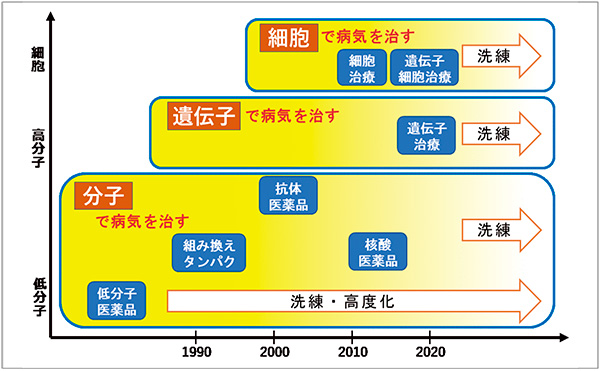
Source: Created by The Office of Pharmaceutical Industry Researchwith reference to "Designer Cells: Challenges in Regeneration, Cell Medicine, and Gene Therapy," Center for Research and Development Strategy
The Case of Calcitonin gene-related peptide inhibitor
There are four NMEs (galcanezumab, eptinezumab, fremanezumab, and erenumab) for calcitonin gene-related peptide (CGRP) inhibitors as approved antibody drugs. include those that neutralize CGRP itself and inhibit signaling, and those that bind to CGRP receptors and inhibit signaling. As of September 2021, there are a total of five small molecule drugs with MoAs other than antibody drugs that have reached the clinical stage or later (as of September 2021), and rimegepant sulfate, ubrogepant, and atogepant have been approved in the United States, where development is in progress, while zavegepant hydrochloride In the United States, where development is in progress, rimegepant sulfate, ubrogepant, and atogepant have been approved, and zavegepant hydrochloride is in Phase 3. None of these small molecule drugs has been approved in Japan ( Table 1 ).
Table 1 CGRP inhibitors approved
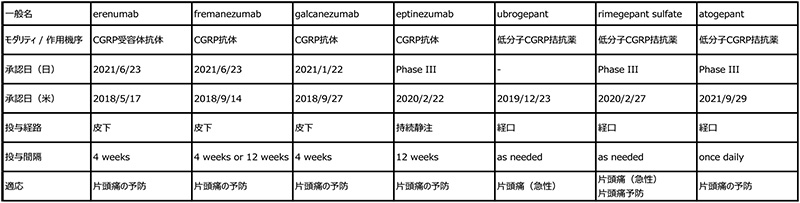
Source: Prepared by The Office of Pharmaceutical Industry Researchbased on information in each drug's package insert and search results on Pharmaprojects (as of September 2021)
The history of research and development of drugs with MoA is long, and in 1999, clinical trials were conducted for Olcegepant, a small molecule drug, and it was shown to abort attacks of migraine headaches*7. The large molecular weight of the drug (approximately 870 mg) and its pharmacokinetic characteristics may have made oral administration an unfeasible option. Although the development of this drug was eventually halted, several orally available small molecule drugs were subsequently identified for research and development. However, these compounds also commonly encountered safety issues due to hepatotoxicity, etc., and R&D was suspended*8 Subsequently, R&D targeting CGRP with antibody drugs was initiated, and since the approval of erenumab in 2018, a total of four antibody drugs have been approved through 2020. Since the approval of erenumab in 2018, a total of four antibody drugs have been approved through 2020. These antibody drugs are used prophylactically for migraine, taking advantage of their safety and long half-life based on the high target selectivity of antibody drugs, and are administered subcutaneously or intravenously once a month or once every three months. Although antibody drugs have taken the lead in practical application, research and development of small molecule drugs is also ongoing, and ubrogepant, which overcame the aforementioned issues, was approved for the first time as a small molecule drug in 2019 (none of the small molecule drugs are approved in Japan). This is an orally administrable drug that takes advantage of the characteristics of small molecule drugs and can be used as an abortive treatment for acute migraine attacks. Rimegepant sulfate, the second small molecule to be approved, can be used either as an abortive or prophylactic agent, and can be used for the same indications as antibody drugs.
CGRP inhibitors have only recently appeared on the market, and it is still unclear how each of these drugs will be positioned in the treatment and prevention of migraine in the future. However, it is expected that the various medical needs in the migraine area will be met by taking advantage of the characteristics of each modality and comprehensively evaluating the value of each drug, including not only efficacy and safety, but also differences in dosage and drug cost.
-
※7Olesen J, Diener HC, Husstedt IW, et al. Calcitonin gene-related peptide receptor antagonist BIBN 4096 BS for the acute treatment of migraine. N Engl J Med 2004 Mar 11;350(11):1104-10
-
8 *9Mamoru Shibata, "Novel treatment of migraine with CGRP-related antibodies," Clinical Neurology, vol. 60, 668-676, 2020
Case Studies in Spinal Muscular Atrophy Drugs
Spinal Muscular Atrophy (SMA) is an autosomal recessive neuromuscular disease caused by a deficiency or deletion of the Survival Motor Neuron (SMN) protein. The disease is associated with progressive muscle atrophy and respiratory failure shortly after birth, leading to early death in severe cases. In recent years, three innovative new drugs have been launched for the treatment of this disease, and these drugs are bringing gospel to patients ( Table 2 ). Although the mechanisms of action of these three drugs are strictly different, they share the common feature of replacing the SMN protein function.
Table 2 Recently approved drugs for SMA
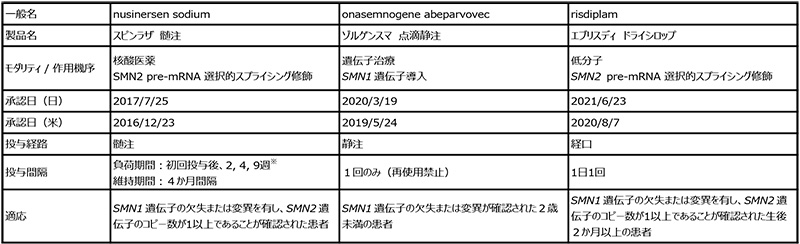
Source: Prepared by The Office of Pharmaceutical Industry Researchbased on information from each drug's package insert and Pharmaprojects search results (as of September 2021)
Spinraza intramedullary injection ("Spinraza"), classified as a nucleic acid medicine, is a drug*9 that has a therapeutic effect on SMA by enhancing SMN2 gene expression and replenishing SMN protein function. It was approved in Japan in 2017. Spinraza is administered intrathecally via lumbar puncture and is administered at 2, 4, and 9 weeks after the initial dose for infantile spinal muscular atrophy, and at 4-month intervals thereafter.
Next, Zorgensma intravenous infusion (hereinafter referred to as "Zorgensma") is a drug classified as a gene therapy, which carries the SMN1 gene in the AAV vector and, like Spinraza, has a therapeutic effect on SMA by replacing the SMN protein function.10 Zorgensma is administered intravenously and systemically. 10 Zorgensma was approved in Japan in 2020 as an intravenously administered systemic drug. It is a drug that is administered only once and has a long-lasting effect.
In 2021, a small molecule drug called Ebrisdi Dry Syrup ("Ebrisdi") was approved in Japan for the treatment of SMA. Ebrisdi is designed to treat SMA by increasing SMN protein through a mechanism of action called SMN2 splicing modification*11. Ebrisdi can be administered orally and is a once-daily drug administered as a dry syrup.
The three drugs recently approved for the treatment of SMA are based on different modalities, and their usefulness has been confirmed in clinical trials. Each of the three drugs has its own characteristics, such as differences in dosage based on the different modalities and differences in drug costs. In the future, data on efficacy and safety will be accumulated and updated, and various characteristics other than efficacy and safety will also be taken into consideration to contribute to the fulfillment of unmet medical needs. In addition, studies are underway to examine the combination of these drugs and the effect of switching between them, and the results of these studies are highly anticipated*12*13 I feel that it is the mission of pharmaceutical companies to create distinctive new drugs using a variety of modalities and to provide patients with choices.
-
9 *9Spinraza intrathecal injection attachment https://www.info.pmda.go.jp/go/pack/1190403A1022_1_06/
-
*9 *10Zorgensma intravenous infusion attachment https://www.info.pmda.go.jp/zgo/pack/300242/4900404X1020_A_01_03/
-
11 *12Ebrisdi Dry Syrup Attachment https://www.info.pmda.go.jp/go/pack/1190029R1028_1_01/
-
*12 *13Harada Y, Rao VK, Arya K, et al. Combination molecular therapies for type 1 spinal muscular atrophy. Muscle Nerve. 2020 Oct;62(4):550-554
-
*13Oechsel KF, Cartwright MS. Combination therapy with onasemnogene and risdiplam in spinal muscular atrophy type 1. Muscle Nerve. 2021 Oct;64 (4):487- 490.
Summary and Future Outlook
As modalities become more diverse and polymeric, it has become possible to add a variety of functions to drugs. On the other hand, we have also observed the growing presence of small- and mid-molecular drugs*14. As seen in the area of SMA therapeutics, substituting the functions of biopharmaceuticals with smaller molecules may become a trend in drug discovery research in the future. In general, small molecule drugs are characterized by high oral absorption and are convenient to administer, although this depends on the disease and the symptoms of each patient. In addition, in general, small molecule drugs are said to be less expensive to manufacture than biopharmaceuticals*15, which may benefit healthcare economics as well. Drug discovery targets that were previously inaccessible with conventional small molecule drugs can now be accessed through the development of science and technology (elucidation of disease mechanisms, utilization of AI and in silico technology, expansion of experimental and evaluation systems such as iPS cell and genome editing technology, practical application of ultra-high-throughput screening, practical application of cryo-EM and other analytical instruments, and the development of new drug discovery technologies such as the use of proteomics, etc.). The development of new technologies based on small molecule drugs such as Protein degrader, and advances in formulation technologies) have led to the availability of seeds with promising profiles as pharmaceuticals. In the past, low-molecular-weight drugs mainly consisted of molecules with molecular weights of 500 or less, which fell under "Lipinski's rule of five," but in recent years, relatively large low-molecular-weight drugs with molecular weights approaching 1000 (classified as low-molecular-weight drugs according to Evaluate's definition) have been introduced into the market. However, in recent years, relatively large small molecule drugs with molecular weights approaching 1,000 (classified as small molecule drugs by Evaluate's definition, but sometimes referred to as mid-molecule drugs) have also been seen. This situation is discussed in detail in the Research Paper Series No. 72, "The Future of Small Molecular Drugs from the Perspective of Drug Discovery Chemistry: Expansion from Small to Medium Molecular Drugs," published by the National Institute for Drug Discovery Research (NIDRC).
Biopharmaceuticals are evolving as a new modality through molecular diversification and complexity, and are expected to play a very important role in future pharmaceuticals, but at the same time, small- and medium-molecule drugs are beginning to be in the spotlight again, and a trend toward lower molecular weight modalities can be seen. What is important for pharmaceuticals is not only efficacy and safety, but also the value of the drug itself, including convenience of administration and price, and what the modality is is not a major issue. In the future, several unique drugs based on various modalities will be developed to meet diversifying needs, and patients themselves will be able to select the drug with the highest value for them.
-
*14 *15(Here, a mid-molecule is defined as a chemically synthesizable drug with a molecular weight of about 500-2000.
-
*15 *16Ministry of Health, Labour and Welfare-sponsored "Biopharmaceuticals and Biosimilars Promotion and Awareness Program" workshop, "Basic Knowledge of Biopharmaceuticals and Biosimilars," https://www.mhlw.go.jp/content/10800000/000655557.pdf (accessed September 30, 2021).
-
16 *17The Office of Pharmaceutical Industry Research Future Prospects for Small Molecular Drugs from Aspects of Drug Discovery Chemistry," Research Paper Series No. 72 (May 2018)
( The Office of Pharmaceutical Industry Research Senior Researcher Yosuke Takahashi )