


Drug Information Q&A Q55. What kind of drugs do you expect to see in the near future?
Answer
There are high expectations for the development of drugs for Alzheimer's disease, diabetic complications, cancer, immune disorders, and other diseases for which no definitive treatments have been developed to date, and to meet these expectations, the pharmaceutical industry is currently focusing on development efforts.
Explanation
Currently, there are only a few countries in the world that are capable of creating new drugs. Japan is one of those few.
Countries such as the U.S., U.K., and Switzerland, which have been producing new drugs for only 100 years, have repeatedly made technological innovations and produced a series of drugs that can be called epoch-making. These drugs have contributed greatly to the health of people around the world and to the development of medicine.
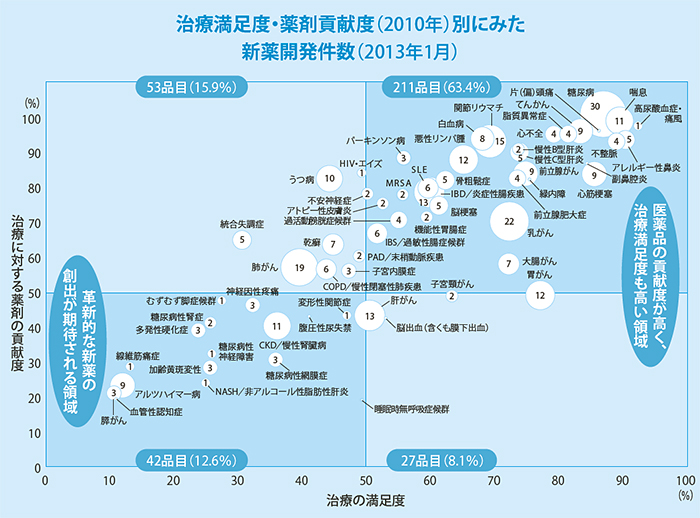
The column on the next page shows the relationship between the level of satisfaction with treatment of various diseases and the contribution of drugs to that satisfaction, based on a survey of physicians. Overall, physicians tend to be satisfied with treatment when the contribution of drugs is high.
For example, allergic rhinitis, asthma, diabetes, epilepsy, and dyslipidemia have high levels of satisfaction with both the contribution of drugs and treatment.
On the other hand, however, there are still many diseases for which treatment is needed but the needs (demands for treatment) are not being met. These include pancreatic cancer, Alzheimer's disease, diabetic neuropathy and diabetic nephropathy. These remain diseases where the contribution of drugs and satisfaction with treatment is low.
The pharmaceutical industry considers the development of innovative drugs for these diseases to be an important mission and is focusing on their development.
Approximately 70 new drugs are under development (as of January 2013) for diseases for which the contribution of drugs is low, and it is expected that they will be used for treatment in the near future. We hope that these new drugs will contribute to the treatment and health of as many patients as possible by increasing the number of diseases that can be cured with medicines.
MINI Column New Drug Development Status by Treatment Satisfaction
Comparing 2005 and 2010 data on treatment satisfaction, the launch of new drugs has improved treatment satisfaction and the contribution of drugs to treatment in many areas, such as rheumatoid arthritis, osteoporosis, and cerebral infarction. However, 12.6% (42 drugs) of the new drugs in development or to be approved are still in areas where both the contribution of the drug to the treatment of the disease and physician satisfaction with the treatment are low (lower left quadrant).
The pharmaceutical industry will continue to develop drugs that can meet unmet medical needs.
- *Treatment satisfaction level is based on 2010; development status of new drugs is based on January 2013 research.
Figures in ○ indicate the number of new drugs under development (Ph1 to under filing) by the top 20 pharmaceutical companies in Japan in terms of sales.
Number of New Drugs Developed by Treatment Satisfaction and Drug Contribution (2010) (January 2013)
Source: Adapted from " OPIR Views and ActionsNo. 38" (March 2013).
Recommended Contents
-
Let's have fun learning about basic knowledge of drugs and how to use them correctly with Capsule-kun!

-
Information for patients and their families on health conditions and provision of medical care.

-
As people get older, the number of medicines they take increases, causing side effects and making it difficult for them to take their medicines properly.
