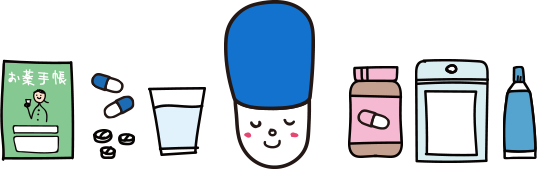










Why do you think there are so many different kinds of drugs and in so many different forms? Let's solve this riddle together!

There are two types of drugs: ethical drugs and over-the-counter drugs.
Ethical drugs are prescribed by a doctor after a medical examination. Because they are highly effective and require attention to side effects, they are only available at hospitals or pharmacies.
OTC drugs are available not only at pharmacies but also at drugstores, etc. They are classified as Class 1 drugs, Class 2 drugs, Class 3 drugs, Class 4 drugs, Class 5 drugs, Class 6 drugs, Class 7 drugs, Class 8 drugs, Class 9 drugs, Class 10 drugs, and Class 11 drugs, Class 1 drugs, Class 2 drugs, and Class 3 drugs, in descending order of necessity for the involvement of a pharmacist or registered sales representative. Most OTC drugs are less effective than those obtained at hospitals.
However, since side effects may occur, it is advisable to consult with a pharmacist or registered sales representative at the store before purchasing OTC drugs to ensure that you select the right drugs for you.

Drugs must be approved by the Minister of Health, Labor and Welfare or prefectural governor for the purpose of prevention, treatment and diagnosis of diseases.
Drugs available at drugstores and other stores are designed with safety in mind.

Due to the revision of the Pharmaceutical Affairs Law (Yakkiho ), the law governing pharmaceuticals, drugs that have been approved as highly safe can now be purchased at convenience stores and supermarkets.
You can buy medicines whenever you have a sudden stomach ache or other problems. However, despite the convenience, it is important to remember that medicines have side effects, and it is important to have correct knowledge about medicines.
When purchasing medicines, consult a pharmacist or registered sales representative.
Also, before using a medicine, read the instructions for use together with your family.